
Wydawca: Packt Publishing
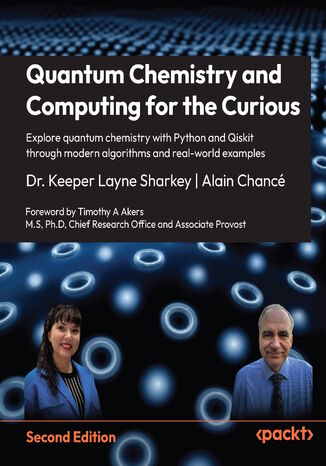
Dr. Keeper Layne Sharkey, Alain Chancé, Timothy...
Build a solid foundation in quantum chemistry and quantum computing using modern tools, updated frameworks, and practical Python examples. In its second edition, this book enhances the original with new chapters and refreshed workflows aligned with the latest advancements.You begin with core principles of quantum mechanics, quantum information, and molecular Hamiltonians, updated to incorporate the latest Qiskit capabilities. You then implement hybrid algorithms such as VQE using improved Python workflows. New to this edition, you will explore noise aware quantum chemistry, including error mitigation techniques and optimizer behavior in realistic simulations. The book also introduces quantum machine learning for molecular prediction and a new generation of quantum algorithms for chemistry, including Quantum Phase Estimation (QPE), Quantum Imaginary Time Evolution (QITE), quantum Lanczos and subspace methods, and sampling based approaches such as Sample based Quantum Diagonalization (SQD), Sample based Krylov Quantum Diagonalization (SKQD), and SqDRIFT, which combines SKQD with a qDRIFT style randomized compilation of the Hamiltonian propagator.By the end of this book, you will be able to model molecular systems and apply modern quantum techniques with confidence.
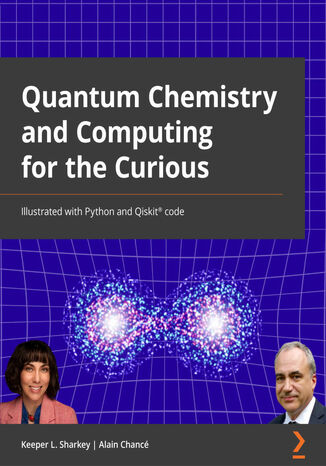
Quantum Chemistry and Computing for the Curious. Illustrated with Python and Qiskit® code
Keeper Layne Sharkey, Alex Khan, Alain Chancé
Explore quantum chemical concepts and the postulates of quantum mechanics in a modern fashion, with the intent to see how chemistry and computing intertwine. Along the way you’ll relate these concepts to quantum information theory and computation. We build a framework of computational tools that lead you through traditional computational methods and straight to the forefront of exciting opportunities. These opportunities will rely on achieving next-generation accuracy by going further than the standard approximations such as beyond Born-Oppenheimer calculations.Discover how leveraging quantum chemistry and computing is a key enabler for overcoming major challenges in the broader chemical industry. The skills that you will learn can be utilized to solve new-age business needs that specifically hinge on quantum chemistry
Quantum Computing Algorithms. Discover how a little math goes a long way
Barry Burd
Navigate the quantum computing spectrum with this book, bridging the gap between abstract, math-heavy texts and math-avoidant beginner guides. Unlike intermediate-level books that often leave gaps in comprehension, this all-encompassing guide offers the missing links you need to truly understand the subject.Balancing intuition and rigor, this book empowers you to become a master of quantum algorithms. No longer confined to canned examples, you'll acquire the skills necessary to craft your own quantum code. Quantum Computing Algorithms is organized into four sections to build your expertise progressively.The first section lays the foundation with essential quantum concepts, ensuring that you grasp qubits, their representation, and their transformations. Moving to quantum algorithms, the second section focuses on pivotal algorithms — specifically, quantum key distribution and teleportation.The third section demonstrates the transformative power of algorithms that outpace classical computation and makes way for the fourth section, helping you to expand your horizons by exploring alternative quantum computing models.By the end of this book, quantum algorithms will cease to be mystifying as you make this knowledge your asset and enter a new era of computation, where you have the power to shape the code of reality.
Arunkumar Krishnakumar
Are quantum computing and Blockchain on a collision course or will they be the most important trends of this decade to disrupt industries and life as we know it?Fintech veteran and venture capitalist Arunkumar Krishnakumar cuts through the hype to bring us a first-hand look into how quantum computing and Blockchain together are redefining industries, including fintech, healthcare, and research. Through a series of interviews with domain experts, he also explores these technologies’ potential to transform national and global governance and policies – from how elections are conducted and how smart cities can be designed and optimized for the environment, to what cyberwarfare enabled by quantum cryptography might look like. In doing so, he also highlights challenges that these technologies have to overcome to go mainstream.Quantum Computing and Blockchain in Business explores the potential changes that quantum computing and Blockchain might bring about in the real world. After expanding on the key concepts and techniques, such as applied cryptography, qubits, and digital annealing, that underpin quantum computing and Blockchain, the book dives into how major industries will be impacted by these technologies. Lastly, we consider how the two technologies may come together in a complimentary way.
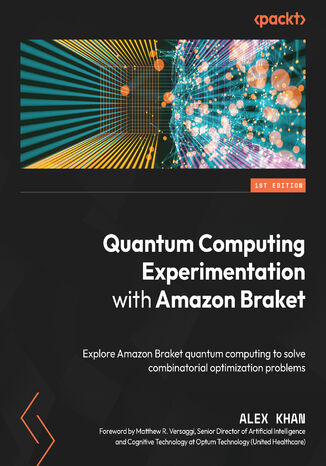
Alex Khan
Amazon Braket is a cloud-based pay-per-use platform for executing quantum algorithms on cutting-edge quantum computers and simulators. It is ideal for developing robust apps with the latest quantum devices.With this book, you'll take a hands-on approach to learning how to take real-world problems and run them on quantum devices. You'll begin with an introduction to the Amazon Braket platform and learn about the devices currently available on the platform, their benefits, and their purpose. Then, you'll review key quantum concepts and algorithms critical to converting real-world problems into a quantum circuit or binary quadratic model based on the appropriate device and its capability. The book also covers various optimization use cases, along with an explanation of the code. Finally, you'll work with a framework using code examples that will help to solve your use cases with quantum and quantum-inspired technologies. Later chapters cover custom-built functions and include almost 200 figures and diagrams to visualize key concepts. You’ll be able to scan the capabilities provided by Amazon Braket and explore the functions to adapt them for specific use cases.By the end of this book, you’ll have the tools to integrate your current business apps and AWS data with Amazon Braket to solve constrained and multi-objective optimization problems.
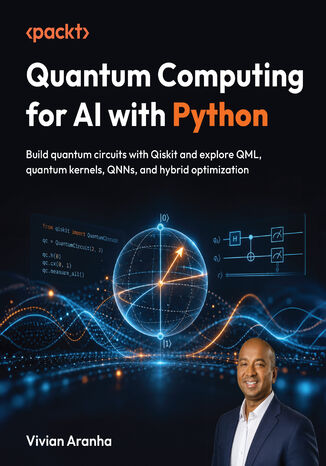
Vivian Aranha
Quantum machine learning sits at the intersection of two fields, yet most learners encounter artificial intelligence and quantum computing as separate subjects. This book bridges that gap with a beginner-friendly, code-led path that explains the classical AI foundations first, then shows how quantum methods are introduced through Python and Qiskit.You will start with machine learning, model evaluation, neural networks, deep learning, and reinforcement learning using scikit-learn, TensorFlow, and PyTorch. The journey then moves into qubits, superposition, entanglement, measurement, quantum gates, and circuit construction before exploring Grover's search, the Quantum Fourier Transform, phase estimation, and the ideas behind Shor's algorithm.With these foundations in place, you will explore quantum feature maps, quantum kernels, variational quantum classifiers, quantum neural networks, and hybrid quantum-classical models. The book also introduces QAOA, VQE, quantum annealing, and applied examples in portfolio optimization, quantum chemistry, and cybersecurity. Rather than promising automatic quantum advantage, it helps you understand what these techniques do, how to prototype them, and where they fit alongside classical AI. By the end, you will be able to build and explain practical QML workflows with Python and Qiskit.
Hassi Norlen
IBM Quantum Experience® is a leading platform for programming quantum computers and implementing quantum solutions directly on the cloud. This book will help you get up to speed with programming quantum computers and provide solutions to the most common problems and challenges.You’ll start with a high-level overview of IBM Quantum Experience® and Qiskit®, where you will perform the installation while writing some basic quantum programs. This introduction puts less emphasis on the theoretical framework and more emphasis on recent developments such as Shor’s algorithm and Grover’s algorithm. Next, you’ll delve into Qiskit®, a quantum information science toolkit, and its constituent packages such as Terra, Aer, Ignis, and Aqua. You’ll cover these packages in detail, exploring their benefits and use cases. Later, you’ll discover various quantum gates that Qiskit® offers and even deconstruct a quantum program with their help, before going on to compare Noisy Intermediate-Scale Quantum (NISQ) and Universal Fault-Tolerant quantum computing using simulators and actual hardware. Finally, you’ll explore quantum algorithms and understand how they differ from classical algorithms, along with learning how to use pre-packaged algorithms in Qiskit® Aqua.By the end of this quantum computing book, you’ll be able to build and execute your own quantum programs using IBM Quantum Experience® and Qiskit® with Python.
Srinjoy Ganguly, Thomas Cambier
Quantum computing is a growing field, with many research projects focusing on programming quantum computers in the most efficient way possible. One of the biggest challenges faced with existing languages is that they work on low-level circuit model details and are not able to represent quantum programs accurately. Developed by researchers at ETH Zurich after analyzing languages including Q# and Qiskit, Silq is a high-level programming language that can be viewed as the C++ of quantum computers! Quantum Computing with Silq Programming helps you explore Silq and its intuitive and simple syntax to enable you to describe complex tasks with less code. This book will help you get to grips with the constructs of the Silq and show you how to write quantum programs with it. You’ll learn how to use Silq to program quantum algorithms to solve existing and complex tasks. Using quantum algorithms, you’ll also gain practical experience in useful applications such as quantum error correction, cryptography, and quantum machine learning. Finally, you’ll discover how to optimize the programming of quantum computers with the simple Silq.By the end of this Silq book, you’ll have mastered the features of Silq and be able to build efficient quantum applications independently.