
Publisher: 8
Sravani Bhattacharjee
Securing connected industries and autonomous systems is of primary concern to the Industrial Internet of Things (IIoT) community. Unlike cybersecurity, cyber-physical security directly ties to system reliability as well as human and environmental safety.This hands-on guide begins by establishing the foundational concepts of IIoT security with the help of real-world case studies, threat models, and reference architectures. You’ll work with practical tools to design risk-based security controls for industrial use cases and gain practical knowledge of multi-layered defense techniques, including identity and access management (IAM), endpoint security, and communication infrastructure. You’ll also understand how to secure IIoT lifecycle processes, standardization, and governance. In the concluding chapters, you’ll explore the design and implementation of resilient connected systems with emerging technologies such as blockchain, artificial intelligence, and machine learning.By the end of this book, you’ll be equipped with the all the knowledge required to design industry-standard IoT systems confidently.
Brian Russell, Drew Van Duren
With the advent of Internet of Things (IoT), businesses will be faced with defending against new types of threats. The business ecosystem now includes cloud computing infrastructure, mobile and fixed endpoints that open up new attack surfaces, a desire to share information with many stakeholders and a need to take action quickly based on large quantities of collected data. . It therefore becomes critical to ensure that cyber security threats are contained to a minimum when implementing new IoT services and solutions. . The interconnectivity of people, devices, and companies raises stakes to a new level as computing and action become even more mobile, everything becomes connected to the cloud, and infrastructure is strained to securely manage the billions of devices that will connect us all to the IoT. This book shows you how to implement cyber-security solutions, IoT design best practices and risk mitigation methodologies to address device and infrastructure threats to IoT solutions.This book will take readers on a journey that begins with understanding the IoT and how it can be applied in various industries, goes on to describe the security challenges associated with the IoT, and then provides a set of guidelines to architect and deploy a secure IoT in your Enterprise. The book will showcase how the IoT is implemented in early-adopting industries and describe how lessons can be learned and shared across diverse industries to support a secure IoT.
Brian Russell, Drew Van Duren
With the advent of the Internet of Things (IoT), businesses have to defend against new types of threat. The business ecosystem now includes the cloud computing infrastructure, mobile and fixed endpoints that open up new attack surfaces. It therefore becomes critical to ensure that cybersecurity threats are contained to a minimum when implementing new IoT services and solutions.This book shows you how to implement cybersecurity solutions, IoT design best practices, and risk mitigation methodologies to address device and infrastructure threats to IoT solutions.In this second edition, you will go through some typical and unique vulnerabilities seen within various layers of the IoT technology stack and also learn new ways in which IT and physical threats interact. You will then explore the different engineering approaches a developer/manufacturer might take to securely design and deploy IoT devices. Furthermore, you will securely develop your own custom additions for an enterprise IoT implementation. You will also be provided with actionable guidance through setting up a cryptographic infrastructure for your IoT implementations. You will then be guided on the selection and configuration of Identity and Access Management solutions for an IoT implementation. In conclusion, you will explore cloud security architectures and security best practices for operating and managing cross-organizational, multi-domain IoT deployments.
Arvind Ravulavaru
In this world of technology upgrades, IoT is currently leading with its promise to make the world a more smarter and efficient place.This book will show you how to build simple IoT solutions that will help you to understand how this technology works. We would not only explore the IoT solution stack, but we will also see how to do it with the world’s most misunderstood programming language - JavaScript. Using Raspberry Pi 3 and JavaScript (ES5/ES6) as the base to build all the projects, you will begin with learning about the fundamentals of IoT and then build a standard framework for developing all the applications covered in this book. You will then move on to build a weather station with temperature, humidity and moisture sensors and further integrate Alexa with it. Further, you will build a smart wearable for understanding the concept of fall detection. You will then extend it with the 'If This Then That' (IFTTT) rules engine to send an email on fall detection. Finally, you will be working with the Raspberry Pi 3 camera module and surveillance with a bit of facial detection using Amazon Rekognition platform.At the end of the book, you will not only be able to build standalone exciting IoT applications but also learn how you can extend your projects to another level.
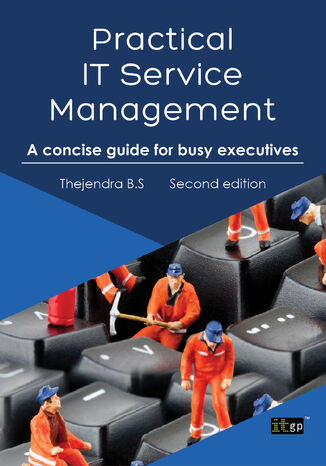
Practical IT Service Management. A concise guide for busy executives
IT Governance Publishing, Thejendra B.S
This book provides a detailed guide to IT service management (ITSM), centered around the ITIL framework to enhance IT service delivery. It starts by introducing foundational concepts such as IT services, common challenges in IT departments, and the evolution of ITIL, particularly the 2011 edition. The early chapters cover core topics like service strategy, design, and the ITIL lifecycle, offering a strong foundation for understanding how ITIL aligns with business objectives.As the book progresses, it delves into key ITIL processes such as service desk management, incident management, problem management, change and release management, and service asset management. Each chapter explains the roles, responsibilities, and best practices for each process, providing actionable advice and real-world examples for effective application. These sections focus on improving service efficiency and handling IT challenges.The final chapters address advanced topics like service level management, financial management, supplier management, and service continuity. These insights help readers manage resources, build vendor relationships, and ensure business continuity. By the end, readers will be equipped to apply ITIL to optimize IT operations, align them with business needs, and drive continuous improvement.
Tajinder Kalsi
Over the last few years, system security has gained a lot of momentum and software professionals are focusing heavily on it. Linux is often treated as a highly secure operating system. However, the reality is that Linux has its share of security ?aws, and these security ?aws allow attackers to get into your system and modify or even destroy your important data. But there’s no need to panic, since there are various mechanisms by which these ?aws can be removed, and this book will help you learn about different types of Linux security to create a more secure Linux system. With a step-by-step recipe approach, the book starts by introducing you to various threats to Linux systems. Then, this book will walk you through customizing the Linux kernel and securing local files. Next, you will move on to managing user authentication both locally and remotely and mitigating network attacks. Later, you will learn about application security and kernel vulnerabilities. You will also learn about patching Bash vulnerability, packet filtering, handling incidents, and monitoring system logs. Finally, you will learn about auditing using system services and performing vulnerability scanning on Linux.By the end of this book, you will be able to secure your Linux systems and create a robust environment.
Tajinder Kalsi
With the growing popularity of Linux, more and more administrators have started moving to the system to create networks or servers for any task. This also makes Linux the first choice for any attacker now. Due to the lack of information about security-related attacks, administrators now face issues in dealing with these attackers as quickly as possible. Learning about the different types of Linux security will help create a more secure Linux system.Whether you are new to Linux administration or experienced, this book will provide you with the skills to make systems more secure.With lots of step-by-step recipes, the book starts by introducing you to various threats to Linux systems. You then get to walk through customizing the Linux kernel and securing local files. Next you will move on to manage user authentication locally and remotely and also mitigate network attacks. Finally, you will learn to patch bash vulnerability and monitor system logs for security.With several screenshots in each example, the book will supply a great learning experience and help you create more secure Linux systems.
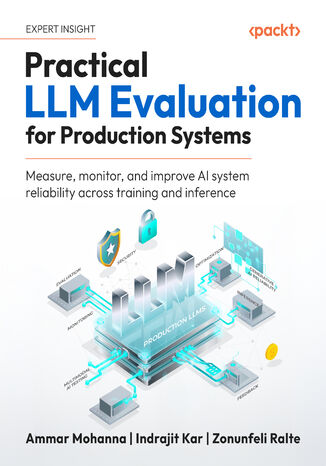
Ammar Mohanna, Indrajit Kar, Zonunfeli Ralte
Modern AI systems are expected to do far more than generate fluent text. They should be able to retrieve information, reason through complex problems, understand images and documents, call external tools, execute workflows, and support critical business decisions. Evaluating these systems requires methods that go beyond traditional NLP benchmarks.Taking a product-first approach, this book presents evaluation as a continuous operational capability spanning training, inference, and end-to-end system operation. You'll learn how to connect evaluation metrics directly to deployment gates, rollback criteria, monitoring systems, and production reliability objectives.Using practical examples and real-world workflows, you'll explore evaluation strategies for text LLMs, vision-language models, multimodal conversational systems, mixture-of-experts architectures, reasoning models, agentic systems, retrieval pipelines, Text2SQL and Text2Cypher systems, embedding models, OCR workflows, and guardrail SLMs. You'll also learn how to manage non-determinism, design repeatable test suites, validate tool execution, and measure long-horizon agent behavior in production.By the end of the book, you'll be able to design robust evaluation systems that help teams deploy reliable, safe, and economically viable LLM-powered applications with confidence.*Email sign-up and proof of purchase required
Dr. Ildar Rakhmatulin
From raw pulse signals to evidence-grounded AI explanations, learn to build the complete workflow. Wearable devices generate continuous photoplethysmography (PPG) data, but motion artifacts, missing samples, limited labels, and individual variability make it difficult to model. Practical LLMs for Healthcare shows you how to apply generative AI beyond text to the challenges of wearable biosignals. See how sequence-modeling ideas from LLMs can be adapted to physiological time series while accounting for noise, timing, and variability.Using Python and real PPG datasets, you will visualize, clean, and tokenize signals; build denoising and Transformer-based time-series models; and pretrain on unlabeled data with self-supervised learning. Generate synthetic PPG with diffusion models, then develop streaming inference, alerting, and personalization workflows for wearable monitoring.Next, connect PPG embeddings to medical knowledge with retrieval-augmented generation (RAG), FAISS vector search, biomedical text encoders, and structured prompts. Explore privacy safeguards, hallucination detection, faithfulness, and clinical benchmarking to evaluate the quality of AI-generated explanations. By the end, you'll understand how to build and assess end-to-end generative AI pipelines for wearable health applications.*Email sign-up and proof of purchase required
Practical Machine Learning Cookbook. Supervised and unsupervised machine learning simplified
Vikram Chandra Jha, Atul Tripathi
Machine learning has become the new black. The challenge in today’s world is the explosion of data from existing legacy data and incoming new structured and unstructured data. The complexity of discovering, understanding, performing analysis, and predicting outcomes on the data using machine learning algorithms is a challenge. This cookbook will help solve everyday challenges you face as a data scientist. The application of various data science techniques and on multiple data sets based on real-world challenges you face will help you appreciate a variety of techniques used in various situations.The first half of the book provides recipes on fairly complex machine-learning systems, where you’ll learn to explore new areas of applications of machine learning and improve its efficiency. That includes recipes on classifications, neural networks, unsupervised and supervised learning, deep learning, reinforcement learning, and more.The second half of the book focuses on three different machine learning case studies, all based on real-world data, and offers solutions and solves specific machine-learning issues in each one.
Sunila Gollapudi
This book explores an extensive range of machine learning techniques uncovering hidden tricks and tips for several types of data using practical and real-world examples. While machine learning can be highly theoretical, this book offers a refreshing hands-on approach without losing sight of the underlying principles. Inside, a full exploration of the various algorithms gives you high-quality guidance so you can begin to see just how effective machine learning is at tackling contemporary challenges of big dataThis is the only book you need to implement a whole suite of open source tools, frameworks, and languages in machine learning. We will cover the leading data science languages, Python and R, and the underrated but powerful Julia, as well as a range of other big data platforms including Spark, Hadoop, and Mahout. Practical Machine Learning is an essential resource for the modern data scientists who want to get to grips with its real-world application.With this book, you will not only learn the fundamentals of machine learning but dive deep into the complexities of real world data before moving on to using Hadoop and its wider ecosystem of tools to process and manage your structured and unstructured data. You will explore different machine learning techniques for both supervised and unsupervised learning; from decision trees to Naïve Bayes classifiers and linear and clustering methods, you will learn strategies for a truly advanced approach to the statistical analysis of data. The book also explores the cutting-edge advancements in machine learning, with worked examples and guidance on deep learning and reinforcement learning, providing you with practical demonstrations and samples that help take the theory–and mystery–out of even the most advanced machine learning methodologies.
Practical Machine Learning on Databricks. Seamlessly transition ML models and MLOps on Databricks
Debu Sinha
Unleash the potential of databricks for end-to-end machine learning with this comprehensive guide, tailored for experienced data scientists and developers transitioning from DIY or other cloud platforms. Building on a strong foundation in Python, Practical Machine Learning on Databricks serves as your roadmap from development to production, covering all intermediary steps using the databricks platform. You’ll start with an overview of machine learning applications, databricks platform features, and MLflow. Next, you’ll dive into data preparation, model selection, and training essentials and discover the power of databricks feature store for precomputing feature tables. You’ll also learn to kickstart your projects using databricks AutoML and automate retraining and deployment through databricks workflows. By the end of this book, you’ll have mastered MLflow for experiment tracking, collaboration, and advanced use cases like model interpretability and governance. The book is enriched with hands-on example code at every step. While primarily focused on generally available features, the book equips you to easily adapt to future innovations in machine learning, databricks, and MLflow.
Brindha Priyadarshini Jeyaraman, Ludvig Renbo Olsen, Monicah...
With huge amounts of data being generated every moment, businesses need applications that apply complex mathematical calculations to data repeatedly and at speed. With machine learning techniques and R, you can easily develop these kinds of applications in an efficient way.Practical Machine Learning with R begins by helping you grasp the basics of machine learning methods, while also highlighting how and why they work. You will understand how to get these algorithms to work in practice, rather than focusing on mathematical derivations. As you progress from one chapter to another, you will gain hands-on experience of building a machine learning solution in R. Next, using R packages such as rpart, random forest, and multiple imputation by chained equations (MICE), you will learn to implement algorithms including neural net classifier, decision trees, and linear and non-linear regression. As you progress through the book, you’ll delve into various machine learning techniques for both supervised and unsupervised learning approaches. In addition to this, you’ll gain insights into partitioning the datasets and mechanisms to evaluate the results from each model and be able to compare them. By the end of this book, you will have gained expertise in solving your business problems, starting by forming a good problem statement, selecting the most appropriate model to solve your problem, and then ensuring that you do not overtrain it.
Robert Galanakis
Practical Maya Programming with Python is a practical tutorial packed with plenty of examples and sample projects which guides you through building reusable, independent modules and handling unexpected errors. If you are a developer looking to build a powerful system using Python and Maya's capabilities, then this book is for you. Practical Maya Programming with Python is perfect for intermediate users with basic experience in Python and Maya who want to better their knowledge and skills.
Idan Habler, Vineeth Sai Narajala
As agentic AI shifts from text generation to operational roles, it relies on the Model Context Protocol (MCP) to interface with databases and execute code. While MCP provides essential connectivity, it introduces a sophisticated attack surface. Practical MCP Security offers a hands-on framework for protecting these autonomous systems throughout their lifecycle.The book begins by deconstructing MCP architecture to establish a rigorous threat model, categorizing risks across supply chain integrity, runtime execution, and code-execution attack vectors. Readers will learn to map these vulnerabilities to testable security controls that mirror adversary behavior. It then details the technical implementation of OAuth 2.1 and scoped authorization, ensuring every interaction is authenticated and auditable.Beyond identity, the guide explores specialized threats like prompt injection, tool poisoning, and rug pull malicious updates. For enterprise production, it covers deployment hardening - including sandboxing, I/O validation, and secrets management - before addressing governance through RBAC, policies, and human-in-the-loop (HITL) mechanisms.Complete with Python implementations and verification checklists, this book provides the professional roadmap required to deploy agentic AI with institutional-grade security.
Practical Memory Forensics. Jumpstart effective forensic analysis of volatile memory
Svetlana Ostrovskaya, Oleg Skulkin
Memory Forensics is a powerful analysis technique that can be used in different areas, from incident response to malware analysis. With memory forensics, you can not only gain key insights into the user's context but also look for unique traces of malware, in some cases, to piece together the puzzle of a sophisticated targeted attack.Starting with an introduction to memory forensics, this book will gradually take you through more modern concepts of hunting and investigating advanced malware using free tools and memory analysis frameworks. This book takes a practical approach and uses memory images from real incidents to help you gain a better understanding of the subject and develop the skills required to investigate and respond to malware-related incidents and complex targeted attacks. You'll cover Windows, Linux, and macOS internals and explore techniques and tools to detect, investigate, and hunt threats using memory forensics. Equipped with this knowledge, you'll be able to create and analyze memory dumps on your own, examine user activity, detect traces of fileless and memory-based malware, and reconstruct the actions taken by threat actors.By the end of this book, you'll be well-versed in memory forensics and have gained hands-on experience of using various tools associated with it.