
Видавець: 8

Andros Fenollosa
The HTML over WebSockets approach simplifies single-page application (SPA) development and lets you bypass learning a JavaScript rendering framework such as React, Vue, or Angular, moving the logic to Python. This web application development book provides you with all the Django tools you need to simplify your developments with real-time results.You’ll learn state-of-the-art WebSocket techniques to realize real-time applications with minimal reliance on JavaScript. This book will also show you how to create a project with Docker from the ground up, test it, and deploy it on a server. You’ll learn how to create a project, add Docker, and discover development libraries, Django channels, and bidirectional communication, and from then, on you’ll create real projects of all kinds using HTML over WebSockets as a chat app or a blog with real-time comments. In addition, you’ll modernize your development techniques by moving from using an SSR model to creating web pages using WebSockets over HTML. With Django, you’ll be able to create SPAs with professional real-time projects where the logic is in Python.By the end of this Django book, you’ll be able to build real-time applications, as well as gaining a solid understanding of WebSockets with Django.
Huy Hoang Nguyen, Paul N Adams, Stuart...
The ability to proficiently perform statistical modeling is a fundamental skill for data scientists and essential for businesses reliant on data insights. Building Statistical Models with Python is a comprehensive guide that will empower you to leverage mathematical and statistical principles in data assessment, understanding, and inference generation.This book not only equips you with skills to navigate the complexities of statistical modeling, but also provides practical guidance for immediate implementation through illustrative examples. Through emphasis on application and code examples, you’ll understand the concepts while gaining hands-on experience. With the help of Python and its essential libraries, you’ll explore key statistical models, including hypothesis testing, regression, time series analysis, classification, and more.By the end of this book, you’ll gain fluency in statistical modeling while harnessing the full potential of Python's rich ecosystem for data analysis.
Flavio E. Goncalves
This book is a well illustrated, step-by-step guide to building a SIP based network using OpenSER. This book is for readers who want to understand how to build a SIP provider from scratch using OpenSER. Telephony and Linux experience will be helpful but is not essential. Readers need not have prior knowledge of OpenSER.
Flavio E. Goncalves, Flavio E Goncalves, Bogdan-Andrei...
OpenSIPS is a multifunctional, multipurpose signalling SIP server. SIP (Session Initiation Protocol) is nowadays the most important VoIP protocol and OpenSIPS is the open source leader in VoIP platforms based on SIP. OpenSIPS is used to set up SIP Proxy servers. The purpose of these servers is to receive, examine, and classify SIP requests. The whole telecommunication industry is changing to an IP environment, and telephony as we know it today will completely change in less than ten years. SIP is the protocol leading this disruptive revolution and it is one of the main protocols on next generation networks. While a VoIP provider is not the only kind of SIP infrastructure created using OpenSIPS, it is certainly one of the most difficult to implement.This book will give you a competitive edge by helping you to create a SIP infrastructure capable of handling tens of thousands of subscribers.Starting with an introduction to SIP and OpenSIPS, you will begin by installing and configuring OpenSIPS. You will be introduced to OpenSIPS Scripting language and OpenSIPS Routing concepts, followed by comprehensive coverage of Subscriber Management. Next, you will learn to install, configure, and customize the OpenSIPS control panel and explore dialplans and routing. You will discover how to manage the dialog module, accounting, NATTraversal, and other new SIP services. The final chapters of the book are dedicated to troubleshooting tools, SIP security, and advanced scenarios including TCP/TLS support, load balancing, asynchronous processing, and more.A fictional VoIP provider is used to explain OpenSIPS and by the end of the book, you will have a simple but complete system to run a VoIP provider.
Jaroslav Pantsjoha, David Fearne
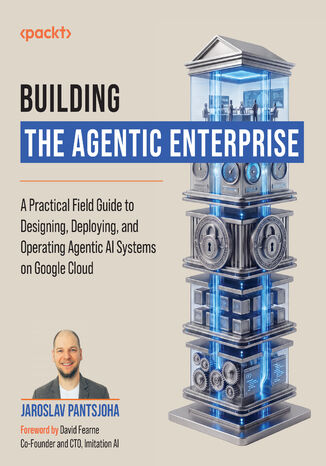
AI can now produce credible demos, prototypes, and proof-of-value concepts faster and more cheaply than most enterprises can absorb. Yet far fewer ever reach production. Building the Agentic Enterprise is a practical field guide to closing that gap: identifying which ideas are worth pursuing and designing the architecture, controls, and operating model needed to make agentic systems reliable, governable, and repeatable.Drawing on two decades of experience across cloud, microservices, and AI, and three years of taking agentic systems into real-world delivery, the book shows why the model is only one part of the challenge. Using Google Cloud and ADK as the practical lens, a continuous case study grounds the patterns, trade-offs, and decisions in a realistic production setting.You will learn how to design agent architectures, orchestration, context, memory, security, observability, governance, and evaluation, while building an AI Squad Model where human experts supervise specialized agents within clear boundaries. The book then expands to the platform and operating model required to scale safely across an organization.By the end, you will be able to judge where agents create real business value, choose the right level of autonomy, and build an agentic capability your organization can trust, operate, govern, and scale.
Alex Merced, Benedikt Stemmildt, Daniel Jones
AI coding agents can generate code in seconds, but without the right engineering practices, they can also introduce bugs, technical debt, and inconsistent code. This book teaches you how to build reliable AI-assisted development workflows that scale from individual projects to entire teams, regardless of which coding assistant or model you use.Rather than treating AI as a black box, you'll learn how AI coding agents work, why they succeed or fail, and how to build systems that consistently produce better results. You'll explore practical methods such as context and harness engineering, along with reusable frameworks such as AEMM, Elastic Loop, and Context Diseases, which you can apply to any development workflow.You'll also learn how to write better specifications, use AI-TDD to improve code quality, build development harnesses that guide AI agents, and choose the right level of autonomy for different tasks. The book also covers AI security, team adoption, and how to scale from individual AI-assisted development to a software factory where multiple AI workflows work together.By the end of this book, you'll understand how to move beyond vibe coding and adopt a disciplined, practical approach to AI-driven software development.

Building the Diverse Community. Beyond Regionalism in East Asia
Dominik Mierzejwski, Grzegorz Bywalec
The processes in East and South Asian became a peculiar subject for global community of international relations in the field. The presented volume is a collection of papers dealing with the processes of regionalization in East and South Asia. We collected papers from different academic unit both from Europe and Asia. Taking regionalization as a core subject of the volume the readers will discover the complexity of ongoing processes in East and South Asia. We present collection of papers from a very different perspectives starting from the theoretical debates, through economic dimensions of integration to political and military scope of regionalization in East and South Asia. The whole volume presents the diversity of understanding among international relations scholars community. By shaping the diverse view we can possess the better and in depth understanding of East Asia.

Manoj Kukreja
Discover the defining hallmarks of future‑ready data platforms, including data mesh architectures, intelligent automation, and end‑to‑end data observability. Learn how to design and deliver trusted data products through data contracts, federated governance, decentralized domain ownership, and endorsed datasets. The book explores modern Lakehouse patterns with a strong focus on the medallion architecture, explaining how bronze, silver, and gold layers transform raw data into analytics‑ready assets governed through Unity Catalog. You’ll gain practical guidance on MDM linkages, survivorship rules, and entity resolution to ensure consistent master data across domains. It also covers real‑time and streaming pipelines that integrate seamlessly with the Lakehouse. We focus on self‑service analytics, showing how governed data products let business users explore, analyze, and derive insights independently with confidence. Finally, understand how GenAI accelerates platform development through automated code generation using tools like Claude Code and Databricks Genie Code, enabling faster pipeline creation, governance, and analytics delivery.