
Publisher: 8
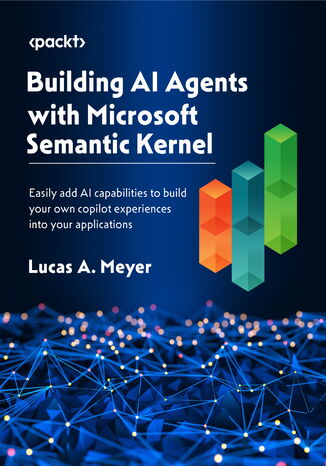
Lucas A. Meyer
In the fast-paced world of AI, developers are constantly seeking efficient ways to integrate AI capabilities into their apps. Microsoft Semantic Kernel simplifies this process by using the GenAI features from Microsoft and OpenAI.Written by Lucas A. Meyer, a Principal Research Scientist in Microsoft’s AI for Good Lab, this book helps you get hands on with Semantic Kernel. It begins by introducing you to different generative AI services such as GPT-3.5 and GPT-4, demonstrating their integration with Semantic Kernel. You’ll then learn to craft prompt templates for reuse across various AI services and variables. Next, you’ll learn how to add functionality to Semantic Kernel by creating your own plugins. The second part of the book shows you how to combine multiple plugins to execute complex actions, and how to let Semantic Kernel use its own AI to solve complex problems by calling plugins, including the ones made by you. The book concludes by teaching you how to use vector databases to expand the memory of your AI services and how to help AI remember the context of earlier requests. You’ll also be guided through several real-world examples of applications, such as RAG and custom GPT agents.By the end of this book, you'll have gained the knowledge you need to start using Semantic Kernel to add AI capabilities to your applications.
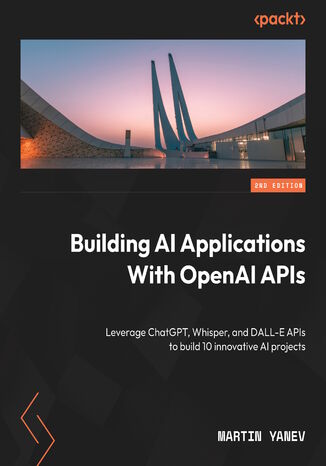
Martin Yanev
Unlock the power of AI in your applications with ChatGPT with this practical guide that shows you how to seamlessly integrate OpenAI APIs into your projects, enabling you to navigate complex APIs and ensure seamless functionality with ease.This new edition is updated with key topics such as OpenAI Embeddings, which’ll help you understand the semantic relationships between words and phrases. You’ll find out how to use ChatGPT, Whisper, and DALL-E APIs through 10 AI projects using the latest OpenAI models, GPT-3.5, and GPT-4, with Visual Studio Code as the IDE. Within these projects, you’ll integrate ChatGPT with frameworks and tools such as Flask, Django, Microsoft Office APIs, and PyQt. You’ll get to grips with NLP tasks, build a ChatGPT clone, and create an AI code bug-fixing SaaS app. The chapters will also take you through speech recognition, text-to-speech capabilities, language translation, generating email replies, creating PowerPoint presentations, and fine-tuning ChatGPT, along with adding payment methods by integrating the ChatGPT API with Stripe.By the end of this book, you’ll be able to develop, deploy, and monetize your own groundbreaking applications by harnessing the full potential of ChatGPT APIs.
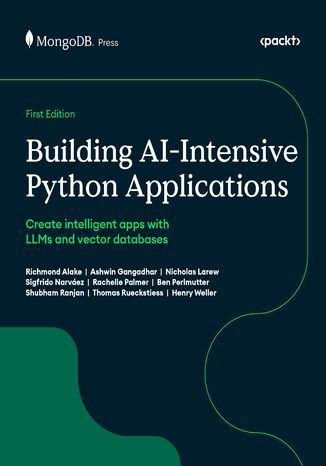
Building AI Intensive Python Applications. Create intelligent apps with LLMs and vector databases
Rachelle Palmer, Ben Perlmutter, Ashwin Gangadhar, Nicholas...
The era of generative AI is upon us, and this book serves as a roadmap to harness its full potential. With its help, you’ll learn the core components of the AI stack: large language models (LLMs), vector databases, and Python frameworks, and see how these technologies work together to create intelligent applications.The chapters will help you discover best practices for data preparation, model selection, and fine-tuning, and teach you advanced techniques such as retrieval-augmented generation (RAG) to overcome common challenges, such as hallucinations and data leakage. You’ll get a solid understanding of vector databases, implement effective vector search strategies, refine models for accuracy, and optimize performance to achieve impactful results. You’ll also identify and address AI failures to ensure your applications deliver reliable and valuable results. By evaluating and improving the output of LLMs, you’ll be able to enhance their performance and relevance.By the end of this book, you’ll be well-equipped to build sophisticated AI applications that deliver real-world value.
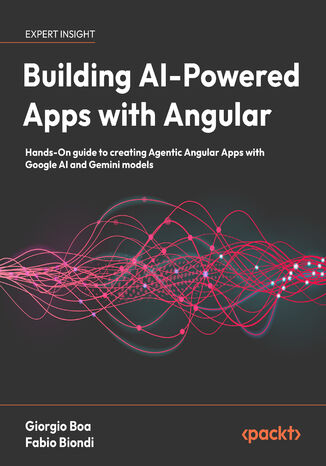
Giorgio Boa, Fabio Biondi, Mark Thompson, Riccardo...
In Building AI-Powered Apps with Angular, you'll embark on an end-to-end journey to revolutionize web development with artificial intelligence. This hands-on guide shows you how to integrate cutting-edge AI capabilities, particularly Large Language Models (LLMs) like Google Gemini and multimodal agents, directly into your Angular applications.Starting with AI/ML fundamentals and an introduction to Google Gemini using Node.js, you’ll quickly progress to building sophisticated AI features within your Angular frontend. You’ll create dynamic content, design intelligent multi-turn chat interfaces, and harness multimodal AI to analyze and generate rich media such as images and videos.The journey extends beyond the frontend. You’ll build robust backends with Angular Server-Side Rendering and Genkit, enabling seamless communication with AI models. You’ll also implement advanced search capabilities using Retrieval Augmented Generation (RAG) and Firestore and learn how to deploy your AI-powered Angular app to the cloud.By the end of the book, you'll have the skills to design, develop, and deploy innovative and intelligent Angular applications that leverage the full potential of AI.
Mehmet Ozkaya
Build practical AI-powered distributed applications by seeing how microservices, messaging, security, data services, and generative AI work together in one project. This book guides you through building a cloud-native e-commerce application with independently deployed services, reliable communication, specialized data stores, and intelligent features.You’ll use Aspire to orchestrate Catalog and Basket microservices, configure service discovery, and integrate PostgreSQL and Redis. You’ll implement synchronous communication and asynchronous messaging with RabbitMQ and MassTransit, secure Basket APIs with Keycloak and JWT bearer tokens, and connect a Blazor frontend to the distributed backend. You’ll then add generative AI capabilities using Microsoft.Extensions.AI, Microsoft Agent Framework, and Ollama. You’ll build customer-support Q&A and semantic product search using embeddings and vector storage before deploying the application to Azure Container Apps. Written by software and solutions architect Mehmet Ozkaya, who has more than 15 years of industry experience and has taught more than 200,000 students, this book combines hands-on development with architectural guidance. By the end, you’ll be able to design, orchestrate, secure, enhance, and deploy AI-enabled distributed .NET applications.
Abhijit Dey, Srinivasan Shanmuganathan, David Roldán Martínez
In today’s financial product landscape, AI is no longer optional, it is non-negotiable.AI is not here to replace product managers and FinTech professionals, but to enhance their skills and amplify their impact. As the industry moves beyond traditional apps into AI-driven platforms, Building AI-Powered Financial Products is the practical guide for everyone building in this space.Unlike financial management books that lean heavily on theory, this book delivers actionable, real-world insights. Each chapter is grounded in real-world scenarios, including a FinTech startup case study that demonstrates frameworks and best practices in action. For financial professionals looking to harness generative AI and LLMs, this book offers the practical tools and templates needed to innovate confidently within regulatory boundaries.By the end, you’ll be equipped to design and scale AI-driven financial products, strengthening your position as a forward-thinking product and FinTech leader in this fast-moving landscape shaped by generative AI.*Email sign-up and proof of purchase required
Building Ambient AI Agents. Create autonomous always-on product experiences that move beyond chat
Frederick Joseph Patton, Leman Pinar Patton
Traditional AI agents perform like customer service reps: they wait. But users get stuck, lose confidence, and quietly leave unable to articulate what's wrong, while the agent lacks the context to help. Building Ambient AI Agents shows a different way. Ambient agents don't wait for a prompt. They read a stream of behavioral signals and act at the right moment, often before the user thinks to ask.In this book, you will go beyond simple chatbots and build an always-on AI agent. First, you will explore the limits of reactive AI systems, before introducing the key principles of ambient agents: observation, memory, and restraint. Then, through hands-on instructions, architectural patterns, and detailed explanations, you will work through the five phases of the agent loop - sense, interpret, decide, act, and learn - to create a complete working ambient AI system. Throughout, you will use Next.js, along with LangGraph to orchestrate stateful agent workflows, Neo4j to provide structured and semantic memory, and CopilotKit AG-UI to deliver real-time user-facing interactions. By the end of the book, you will have built a fully operational ambient AI agent, you will understand how to bridge the gap between reactive and proactive systems, building an always-on ambient AI agent that is constantly observing.
Building an API Product. Design, implement, release, and maintain API products that meet user needs
Bruno Pedro
The exponential increase in the number of APIs is evidence of their widespread adoption by companies seeking to deliver value to users across diverse industries, making the art of building successful APIs an invaluable skill for anyone involved in product development. With this comprehensive guide, you’ll walk through the entire process of planning, designing, implementing, releasing, and maintaining successful API products. You’ll start by exploring all aspects of APIs, including their types, technologies, protocols, and lifecycle stages. Next, you’ll learn how to define an API strategy and identify business objectives, user personas, and jobs-to-be-done (JTBD). With these skills, you’ll delve into designing and validating API capabilities to create a machine-readable API definition. As you advance, the book helps you understand how to choose the right language and framework for securely releasing an API server and offers insights into analyzing API usage metrics, improving performance, and creating compelling documentation that users love. Finally, you’ll discover ways to support users, manage versions, and communicate changes or the retirement of an API.By the end of this API development book, you’ll have the confidence and skills to create API products that truly stand out in the market.