
Видавець: 24
Arkadiusz Włodarczyk
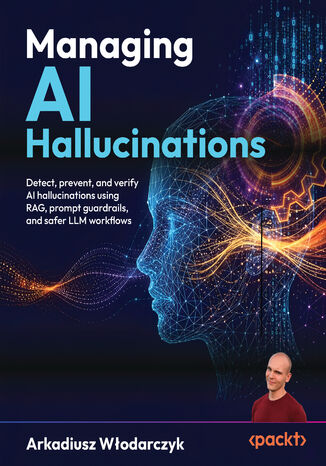
AI systems that sound confident can still be wrong. Managing AI Hallucinations gives you a structured, code-driven approach to identifying, preventing, and verifying unreliable LLM output before errors reach users or decisions.Written by Arkadiusz Włodarczyk, a programming instructor and course creator with 20+ years of experience, the book works through real code examples and walkthroughs. You will learn why language models produce fabricated facts, false references, and overconfident code. You will reduce hallucinations through system instructions, constraints, and few-shot prompting, and ground responses in trusted sources using RAG, vector databases, and NotebookLM. Cross-model comparison, source checks, and self-consistency prompting give you repeatable ways to evaluate claims.Later chapters cover guardrails, output validation, logging, and fallback layers alongside compliance requirements, bias risks, and escalation criteria for responsible deployment. The book closes with a monitoring project built on OpenTelemetry, Prometheus, and Grafana. By the end, you will be able to design and monitor AI workflows that catch failures before they reach users.
Managing AI Risk. A practical approach to responsibly managing AI with ISO 42001
IT Governance Publishing, Andrew Pattison
This book is a comprehensive guide to understanding and managing the risks associated with artificial intelligence (AI) technologies. It begins by exploring the fundamental aspects of AI, from its ethical and philosophical dimensions to its impact on organizational risk.As the book progresses, it delves into the creation of a risk-aware AI strategy, integrating AI risk management into existing organizational frameworks. It offers practical insights on identifying and assessing various risks, including data privacy, algorithmic transparency, and operational challenges related to AI deployment and maintenance.This book is designed for professionals, risk managers, and AI practitioners who seek to navigate the complexities of AI in organizations. Whether you’re just beginning to explore AI risks or looking to refine your existing strategies, this book equips you with the tools needed for effective management.By the end of this book, you will have gained a solid understanding of AI-related risks, be able to implement effective AI risk management frameworks, and integrate AI strategies within your organization.

Bruno Martorelli, Mostafa ElAshmawy
Enhancing the value of BIM data is a pressing challenge in the architecture, engineering, and construction (AEC) industry—this book gives you the tools to solve it with AI. You'll learn to automate BIM data workflows, extract meaningful insights, and design intelligent dashboards using Revit, Dynamo, Power BI, and Python.Written by seasoned BIM Manager Bruno Martorelli, this hands-on guide equips you with the skills to modernize your data processes and build predictive, real-time dashboards customized for stakeholder needs. You'll dive into extracting BIM data, applying machine learning with comfort metrics, visualizing results using Power BI, and even integrating real-time IoT streams into your models.This book also explores ethical and practical considerations of AI in BIM, offers real-world case studies, and gives you the confidence to lead future-ready AEC projects. Whether you're new to AI or already experimenting with dashboards, you’ll walk away ready to make your BIM data work harder and smarter.By the end of this book, you will be able to create powerful, AI-enhanced dashboards and automation workflows that convert raw BIM data into actionable intelligence, transforming your project delivery capabilities.
Ernesto Pellegrino, Manuel André Bottiglieri, Gavin Crump,...
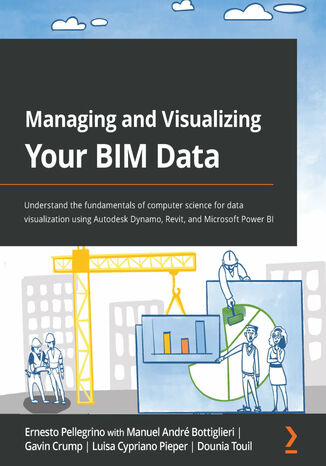
Business intelligence software has rapidly spread its roots in the AEC industry during the last few years. This has happened due to the presence of rich digital data in BIM models whose datasets can be gathered, organized, and visualized through software such as Autodesk Dynamo BIM and Power BI.Managing and Visualizing Your BIM Data helps you understand and implement computer science fundamentals to better absorb the process of creating Dynamo scripts and visualizing the collected data on powerful dashboards. This book provides a hands-on approach and associated methodologies that will have you productive and up and running in no time. After understanding the theoretical aspects of computer science and related topics, you will focus on Autodesk Dynamo to develop scripts to manage data. Later, the book demonstrates four case studies from AEC experts across the world. In this section, you’ll learn how to get started with Autodesk Dynamo to gather data from a Revit model and create a simple C# plugin for Revit to stream data on Power BI directly. As you progress, you’ll explore how to create dynamic Power BI dashboards using Revit floor plans and make a Power BI dashboard to track model issues.By the end of this book, you’ll have learned how to develop a script to gather a model’s data and visualize datasets in Power BI easily.
Managing Data as a Product. Design and build data-product-centered socio-technical architectures
Andrea Gioia, Giulio Scotti
Traditional monolithic data platforms struggle with scalability and burden central data teams with excessive cognitive load, leading to challenges in managing technological debt. As maintenance costs escalate, these platforms lose their ability to provide sustained value over time. With two decades of hands-on experience implementing data solutions and his pioneering work in the Open Data Mesh Initiative, Andrea Gioia brings practical insights and proven strategies for transforming how organizations manage their data assets.Managing Data as a Product introduces a modular and distributed approach to data platform development, centered on the concept of data products. In this book, you’ll explore the rationale behind this shift, understand the core features and structure of data products, and learn how to identify, develop, and operate them in a production environment. The book guides you through designing and implementing an incremental, value-driven strategy for adopting data product-centered architectures, including strategies for securing buy-in from stakeholders. It also covers data modeling in distributed environments and its role in enabling modern generative AI.By the end of this book, you’ll understand product-centric data architecture and how to adopt it.*Email sign-up and proof of purchase required
Jane Sarah Lat
Data integrity management plays a critical role in the success and effectiveness of organizations trying to use financial and operational data to make business decisions. Unfortunately, there is a big gap between the analysis and management of finance data along with the proper implementation of complex data systems across various organizations.The first part of this book covers the important concepts for data quality and data integrity relevant to finance, data, and tech professionals. The second part then focuses on having you use several data tools and platforms to manage and resolve data integrity issues on financial data. The last part of this the book covers intermediate and advanced solutions, including managed cloud-based ledger databases, database locks, and artificial intelligence, to manage the integrity of financial data in systems and databases.After finishing this hands-on book, you will be able to solve various data integrity issues experienced by organizations globally.
Kirill Dubovikov
Data science and machine learning can transform any organization and unlock new opportunities. However, employing the right management strategies is crucial to guide the solution from prototype to production. Traditional approaches often fail as they don't entirely meet the conditions and requirements necessary for current data science projects. In this book, you'll explore the right approach to data science project management, along with useful tips and best practices to guide you along the way. After understanding the practical applications of data science and artificial intelligence, you'll see how to incorporate them into your solutions. Next, you will go through the data science project life cycle, explore the common pitfalls encountered at each step, and learn how to avoid them. Any data science project requires a skilled team, and this book will offer the right advice for hiring and growing a data science team for your organization. Later, you'll be shown how to efficiently manage and improve your data science projects through the use of DevOps and ModelOps. By the end of this book, you will be well versed with various data science solutions and have gained practical insights into tackling the different challenges that you'll encounter on a daily basis.
Martin Bauer
open-source CMS (content management system) and development framework with functionality for web publishing, intranets, e-commerce, extranets, and web portals.In this book, Martin Bauer of designit.com.au an eZ publish Silver partner, teaches you how to successfully manage and implement an eZ publish web content management project. He shows you how to produce quality results in a repeatable manner with the minimum of effort, and end up with eZ publish solutions that will delight your clients.The book presents strategies, best practices, and techniques for all steps of your eZ publish project, starting from client requirements, through planning, information architecture and content modeling, design considerations, and right up to deployment, client training, maintenance, support, and upgrades.