
Publisher: 16

Jack Lauriger
Czasem wystarczy drobny impuls, by nieuświadomione pragnienia znalazły swoje ujście i zmieniły bieg naszego życia… Clarissa to mieszkanka Londynu, kobieta sukcesu, mężatka z dwójką dzieci, która zostaje wysłana w najdłuższą i najtrudniejszą delegację swojego życia. Przez pół roku będzie rozwijać filię swojej brytyjskiej firmy w odległej Polsce. Decydując się podjąć wyzwanie, nie zdaje sobie sprawy, że ta zawodowa misja przerodzi się w podróż do wnętrza samej siebie. Jak pobyt w Polsce wpłynie na jej małżeństwo? Jaką rolę odegra w życiu bohaterki tajemnicza Anna? Clarissa niespodziewanie zmierzy się z zupełnie nowymi doświadczeniami w sferze emocji, seksu i uczuć. „Dzięki Clarissie każda z nas poczuje się rozgrzeszona!” Nadia Szagdaj – polska pisarka, autorka serii powieści „Kroniki Klary Schulz”. Autor powieści, Jack Lauriger, to brytyjski pisarz mieszkający w Polsce od dwudziestu lat. W swoich książkach przeplata bogactwo doświadczeń międzynarodowych ze specyficzną angielską mieszanką humoru i intymnej kreatywnej pikanterii. Główne przesłanie łączące jego powieści brzmi: „prywatne życie to szczęśliwe życie.”

Class and Cultural Narratives. The Upper Silesia Case
Paweł Ćwikła, Monika Gnieciak, Kazimiera Wódz
The emphasis of this book is on understanding local identities through the representations produced and disseminated by local people, residents of working class estates placed in Upper Silesia, captured in the regional literature. Presented analysis of the writings of Kazimierz Kutz and Stefan Szymutko aims to find a panoramic view of a postindustrial world, sensitivity to region’s specificity, awareness of industrial and agricultural past, a gallery of characters entangled with a difficult history of local communities. The assumption which was fundamental to the research was the fact that literature poses a reservoir of identity representations. By means of autobiographies, family stories and regional novels the story of Silesia was retold, constructed out of a variety of memories and personal narratives. Thus the analyzed novels constitute a particular type of social representations of Upper Silesia, the representations which - to a more extent than to an individual – belong to a community within which they are created. Their nature consists in ongoing reproduction, redefinition, constant creation of Upper Silesian's past and presence. Paweł Ćwikła, PhD in sociology, researcher in Department of Contemporary Culture Research, Institute of Sociology, University of Silesia. Monika Gnieciak, M.A. in sociology, University of Silesia, 2001, Katowice, M.A. in science of culture, University of Silesia, 2004, Katowice, PhD in Humanities, University of Silesia, 2007, Katowice. Researcher in Department of Contemporary Culture Research, Institute of Sociology, University of Silesia. Kazimiera Wódz, Professor of Sociology, Head of Department of Cultural Studies and Social Work Unit Institute of Sociology, University of Silesia.

Mercury Learning and Information, Franz Lanzinger
This book teaches you to design and develop classic arcade video games. Using modern, free software tools like Unity, you’ll create five retro games inspired by the classics. All source code, art, and sound files are provided in the companion files. You'll enjoy customizing graphics, adjusting scoring, coding AI, and creating sound effects, gaining a deep understanding of the roots of modern video game design from the '70s and '80s.The course begins with an introduction and essential tools, then guides you through creating various retro games. Each chapter builds on the previous one with detailed instructions, exercises, and classic game design rules. The book includes historical anecdotes from a former Atari programmer and insights on applying classic game design concepts to modern games.Understanding these design elements is crucial for developing engaging video games. This book transitions readers from beginners to proficient game developers, blending theoretical knowledge with practical skills. Companion files enhance the learning experience, making this book an invaluable resource for mastering classic game design with modern tools.
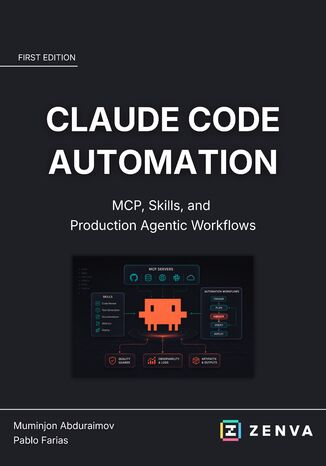
Claude Code Automation. MCP, Skills, and Production Agentic Workflows
Zenva Academy
Useful automation starts with a clear model of what the agent may do, what each tool provides, and where human approval belongs. The opening sections establish project guidance, working memory, planning, and scope controls before introducing the Model Context Protocol. Readers learn how MCP servers expose capabilities through defined tool contracts and why those contracts matter for safe execution.The practical work connects Claude Code to external systems. Readers configure MCP connections, inspect available tools, prepare a local repository, create a GitHub access token, and move through branch, commit, push, and pull-request-oriented tasks. Browser investigation with Playwright adds another layer, showing how an agent can inspect a web application while staying within explicit goals and observable checks.By the end of this guide, readers can design connected workflows rather than isolated prompts. They will be able to combine repository operations, browser automation, and project-level skills into repeatable processes that remain understandable, guarded, and easier to verify.
Claude Code Beyond the Prompt. Build Reusable Claude Skills, Agentic Workflows, and AI Agents
Martin Krause
Claude is powerful, but many people use it in fragile, one-off ways. You prompt, get an answer, and move on. Real work, however, is not a single prompt; it is a sequence of tasks, decisions, and context. This is where one-off interactions break.This book shows you how to move from prompts to skills and toward true agentic engineering. Instead of refining prompts, you will learn a practical, structured way of working with AI by designing skills and workflows that produce consistent results and can be tested, improved, and reused.Through a continuous, hands-on project, you will build AI-driven processes for real tasks such as debugging, documentation, and recurring work. The focus is not on isolated outputs but on systems that hold up under real-world conditions.From here, you will explore how tools, protocols, and agentic systems connect. You will understand how tool calling, context management, and structured execution shift AI work from isolated interactions to coordinated workflows.Rather than teaching you to rely on tools that quickly become outdated, this book helps build a durable mental model for working with AI. By the end, you will not just prompt AI but design how work is carried out with it, using Claude or any AI tool of your choice.
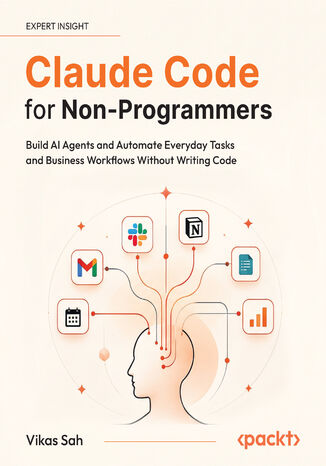
Vikas Sah
What if your emails were organized, reports prepared, and business updates ready before you started work? Claude Code can help you automate these tasks without writing code.This book takes you from your first prompt to becoming an AI operator. You'll learn how to use Claude Code to work with files, connect apps, browse websites, and handle everyday tasks. Instead of copying prompts into a chat window, you'll build AI assistants that can get real work done.Through 8 practical projects, you'll build AI assistants that organize emails, track competitors, manage business information, and prepare reports. You'll also learn to create reusable workflows with skills, subagents, and MCP connections to help Claude Code work across different tools.As you progress, you'll create presentations, websites, and dashboards and explore how several AI agents can work together and handle different tasks. You'll learn to schedule tasks, manage costs, protect sensitive information, and review what your agents do. Many of these tasks keep running on a schedule while you are away.By the end, you'll know how to use Claude Code to automate routine work and manage AI agents that help run your daily operations.
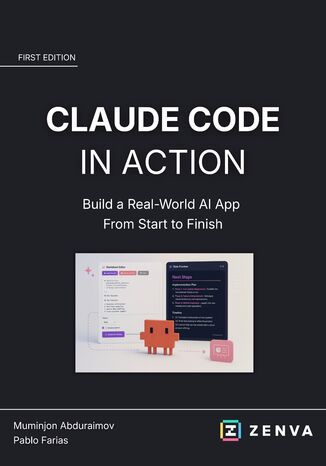
Claude Code in Action. Build a Real-World AI App From Start to Finish
Zenva Academy
Hands-on agentic development becomes clearer when every concept supports a working application. The opening sections prepare Node.js, Claude Code, required accounts, and project files, then introduce the shift from a coding assistant to an active development partner. Readers define the application, organize its core components, and translate frontend, backend, export, and error-handling needs into focused requests.The build then moves from generation to evidence-based troubleshooting. Readers install dependencies, run the application, diagnose the first failures, repair client-server communication, and investigate HTML and JSON exports. Additional work adds a presentation mode and compares hosted and local model providers through OpenAI and Ollama, including configuration and timeout problems that reveal how environment details affect behavior.By the end of this guide, readers can take an AI-assisted application from idea to a tested local result. They will be prepared to prompt with clearer intent, inspect generated code, resolve integration faults, and improve interface details through deliberate iteration.
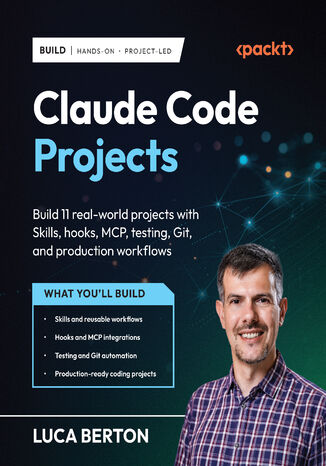
Luca Berton
Claude Code can generate code quickly, but professional development demands more than accepting the first answer. You need a workflow for planning, testing, reviewing, constraining, and shipping AI-assisted changes with confidence.Claude Code Projects teaches that workflow through 11 hands-on projects built around one repeatable loop: plan, implement, test, review, commit. You’ll start with effective prompting and CLAUDE.md project context, then build and compare API implementations, generate persistent tests, debug AI-written code, and use Git as a safety net for every change.As the projects progress, you’ll turn wireframes into working interfaces, refactor legacy code without changing behavior, and package repeatable workflows as Claude Code Skills. You’ll extend Claude Code with hooks, MCP, subagents, worktrees, and plugins while applying least-privilege access and safe automation.Finally, you’ll assess AI-built software for production readiness using evidence, guardrails, rollback thinking, and decisive go/no-go criteria. A capstone brings the full workflow together as you build a new API from scratch, test it, review it, assess readiness, and ship it through a pull request.