
Wydawca: 16

Grań kultury. Transgresje alpinizmu
Marek Pacukiewicz
„Bo jest” – słynna odpowiedź George’a Leigh Mallory’ego na pytanie, dlaczego chce zdobyć Mount Everest – eksponuje doświadczenie ontologiczne jako fundament alpinizmu. Wspinaczka wysokogórska nie jest więc prostym wyjściem ze świata kultury w świat natury, to raczej doświadczenie istnienia granic pomiędzy nimi. Alpinista porusza się właśnie po tej „grani”. Przedmiotem niniejszej książki jest próba dookreślenia kulturowego modelu transgresji w dyskursie alpinizmu: w jaki sposób fundamentalna ontologia doświadczenia liminalnego kształtuje model świata alpinistów oraz jakiego wzorca osobowości im dostarcza. Na materiał badawczy wykorzystany w książce składają się wypowiedzi alpinistów pozyskane w trakcie antropologicznych kwestionariuszowych badań terenowych oraz narracje zaczerpnięte z literatury alpinistycznej. Poprzez ich pryzmat lakoniczne „Bo jest” doświadczenia alpinistycznego przedstawia się w pełni swej złożoności jako kontekstualne zjawisko kulturowe.
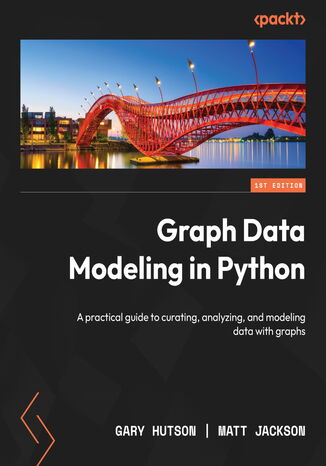
Gary Hutson, Matt Jackson
Graphs have become increasingly integral to powering the products and services we use in our daily lives, driving social media, online shopping recommendations, and even fraud detection. With this book, you’ll see how a good graph data model can help enhance efficiency and unlock hidden insights through complex network analysis.Graph Data Modeling in Python will guide you through designing, implementing, and harnessing a variety of graph data models using the popular open source Python libraries NetworkX and igraph. Following practical use cases and examples, you’ll find out how to design optimal graph models capable of supporting a wide range of queries and features. Moreover, you’ll seamlessly transition from traditional relational databases and tabular data to the dynamic world of graph data structures that allow powerful, path-based analyses. As well as learning how to manage a persistent graph database using Neo4j, you’ll also get to grips with adapting your network model to evolving data requirements.By the end of this book, you’ll be able to transform tabular data into powerful graph data models. In essence, you’ll build your knowledge from beginner to advanced-level practitioner in no time.
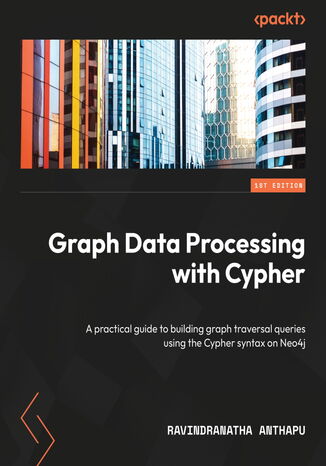
Ravindranatha Anthapu
While it is easy to learn and understand the Cypher declarative language for querying graph databases, it can be very difficult to master it. As graph databases are becoming more mainstream, there is a dearth of content and guidance for developers to leverage database capabilities fully. This book fills the information gap by describing graph traversal patterns in a simple and readable way.This book provides a guided tour of Cypher from understanding the syntax, building a graph data model, and loading the data into graphs to building queries and profiling the queries for best performance. It introduces APOC utilities that can augment Cypher queries to build complex queries. You’ll also be introduced to visualization tools such as Bloom to get the most out of the graph when presenting the results to the end users.After having worked through this book, you’ll have become a seasoned Cypher query developer with a good understanding of the query language and how to use it for the best performance.
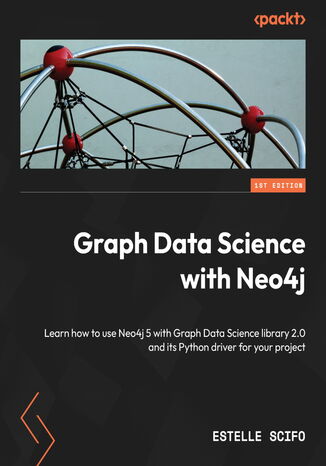
Estelle Scifo
Neo4j, along with its Graph Data Science (GDS) library, is a complete solution to store, query, and analyze graph data. As graph databases are getting more popular among developers, data scientists are likely to face such databases in their career, making it an indispensable skill to work with graph algorithms for extracting context information and improving the overall model prediction performance.Data scientists working with Python will be able to put their knowledge to work with this practical guide to Neo4j and the GDS library that offers step-by-step explanations of essential concepts and practical instructions for implementing data science techniques on graph data using the latest Neo4j version 5 and its associated libraries. You’ll start by querying Neo4j with Cypher and learn how to characterize graph datasets. As you get the hang of running graph algorithms on graph data stored into Neo4j, you’ll understand the new and advanced capabilities of the GDS library that enable you to make predictions and write data science pipelines. Using the newly released GDSL Python driver, you’ll be able to integrate graph algorithms into your ML pipeline.By the end of this book, you’ll be able to take advantage of the relationships in your dataset to improve your current model and make other types of elaborate predictions.
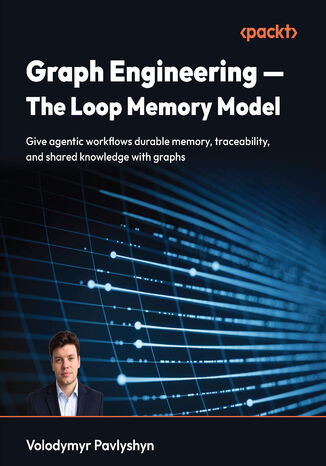
Volodymyr Pavlyshyn
Agent loops are good at producing work, but the reasoning behind that work disappears the moment the context window closes. Two agents rediscover the same bug three sprints apart; a decision made in run 12 gets silently contradicted in run 47.Graph Engineering moves that reasoning out of transcripts and into an explicit knowledge graph. You'll model execution history separately from durable knowledge, then connect the two with a small set of bridge relationships. Markdown stays the authoritative source; the graph is a disposable index built for queries, not a second source of truth.From there, the book turns the model into a working mechanism: parse structured repository data, extract only genuine prose, resolve entities, and assemble typed relations. Retrieve small, relevant neighborhoods instead of dumping an entire knowledge base into context. See how evaluations check supporting paths, how concurrent workers publish changes without corrupting shared state, and how a pipeline preserves lineage from objective to artifact.The final section is judgment; which metrics reveal graph quality, how false merges and bad incentives produce confident errors, what this architecture costs, and when a simple ADR log or relational table is the better answer.
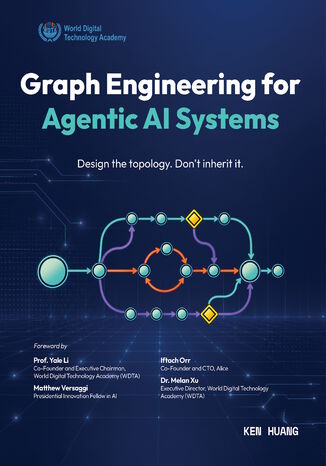
Graph Engineering for Agentic AI Systems. Design the topology. Don't inherit it
Ken Huang, Prof. Yale Li, Iftach Orr,...
Agentic AI systems need more than capable models: they need clear rules for how work runs. Graph Engineering for Agentic AI Systems helps you design that structure, starting with when a single-agent loop is enough and when multi-agent orchestration earns its complexity. Distinguish execution graphs, knowledge graphs, and learned graphs, then explore typed state, routing, parallel fan-out and joins, and human approval gates. Compare runtimes including LangGraph, Google ADK, Microsoft Agent Framework, and the OpenAI Agents SDK.Worked examples, chapter exercises, and companion code connect architecture to implementation. Explore knowledge graph memory and GraphRAG, checkpointing, bounded retries, idempotency, and production observability. Examine permissions and authorization boundaries, then evaluate execution traces, node contracts, and stop conditions. By the end, you'll be equipped to design, test, and operate agent workflows with explicit topology, controlled side effects, and traceable decisions.
Aldo Marzullo, Enrico Deusebio, Claudio Stamile
Graph Machine Learning, Second Edition builds on its predecessor’s success, delivering the latest tools and techniques for this rapidly evolving field. From basic graph theory to advanced ML models, you’ll learn how to represent data as graphs to uncover hidden patterns and relationships, with practical implementation emphasized through refreshed code examples. This thoroughly updated edition replaces outdated examples with modern alternatives such as PyTorch and DGL, available on GitHub to support enhanced learning.The book also introduces new chapters on large language models and temporal graph learning, along with deeper insights into modern graph ML frameworks. Rather than serving as a step-by-step tutorial, it focuses on equipping you with fundamental problem-solving approaches that remain valuable even as specific technologies evolve. You will have a clear framework for assessing and selecting the right tools.By the end of this book, you’ll gain both a solid understanding of graph machine learning theory and the skills to apply it to real-world challenges.*Email sign-up and proof of purchase required -
Claudio Stamile, Aldo Marzullo, Enrico Deusebio
Graph Machine Learning will introduce you to a set of tools used for processing network data and leveraging the power of the relation between entities that can be used for predictive, modeling, and analytics tasks. The first chapters will introduce you to graph theory and graph machine learning, as well as the scope of their potential use. You’ll then learn all you need to know about the main machine learning models for graph representation learning: their purpose, how they work, and how they can be implemented in a wide range of supervised and unsupervised learning applications. You'll build a complete machine learning pipeline, including data processing, model training, and prediction in order to exploit the full potential of graph data. After covering the basics, you’ll be taken through real-world scenarios such as extracting data from social networks, text analytics, and natural language processing (NLP) using graphs and financial transaction systems on graphs. You’ll also learn how to build and scale out data-driven applications for graph analytics to store, query, and process network information, and explore the latest trends on graphs. By the end of this machine learning book, you will have learned essential concepts of graph theory and all the algorithms and techniques used to build successful machine learning applications.