
Loading...
Ebook details
Log in if you are interested in the contents of the item.
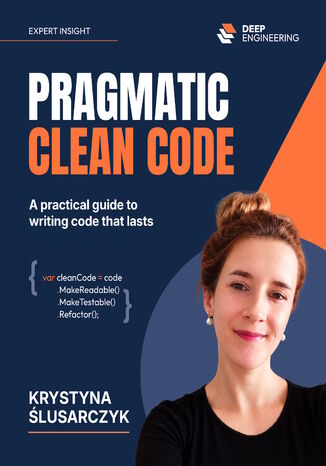
Pragmatic Clean Code. A practical guide to writing code that lasts
Krystyna Ślusarczyk
Loading...
EBOOK
Loading...
Most advice about code quality stops at the surface. Use good names. Keep methods short. This book goes further by explaining why clean code principles exist, what they achieve, and how to apply them with practical judgment.
You’ll begin with naming and method design before moving into classes and the SOLID principles as tools for everyday design decisions. You’ll then explore how coupling, cohesion, reuse, inheritance, and composition affect how easily a system can evolve.
The book also shows why well-designed code tends to be testable code and how dependency injection, unit tests, and mocks make changes safer. Formatting, comments, and other clean-code practices are considered in the situations where they affect maintainability.
Step-by-step refactoring case studies show not only what cleaner code looks like, but why each design decision is made. Although the examples use C#, the principles apply well beyond it, so developers working in other languages will find them useful too.
Written by software developer and programming instructor Krystyna Ślusarczyk, this book emphasizes practical judgment over memorized rules. By the end, you’ll be able to identify maintainability problems and refactor code into software that is easier to understand, test, and change.
- 1. Understanding clean code
- 2. Meaningful names
- 3. Writing better methods
- 4. Formatting code
- 5. Applying the Single Responsibility Principle
- 6. Applying the Open-Closed Principle
- 7. Applying the Liskov Substitution Principle
- 8. Applying the Interface Segregation Principle
- 9. Applying the Dependency Inversion Principle
- 10. Static methods and dependencies
- 11. Designing smaller classes
- 12. Organizing classes and projects
- 13. Balancing coupling, cohesion, and reuse
- 14. Using comments effectively
- 15. Writing testable code and clean tests
- Title:Pragmatic Clean Code. A practical guide to writing code that lasts
- Author:Krystyna Ślusarczyk
- Original title:Pragmatic Clean Code. A practical guide to writing code that lasts
- ISBN:9781808493782, 9781808493782
- Date of issue:2026-09-30
- Format:Ebook - EPUB
- Item ID: e_57rz
- Publisher: Packt Publishing
Loading...
Loading...