
Завантаження...
Деталі електронної книги
Увійти якщо вас цікавить зміст видання.
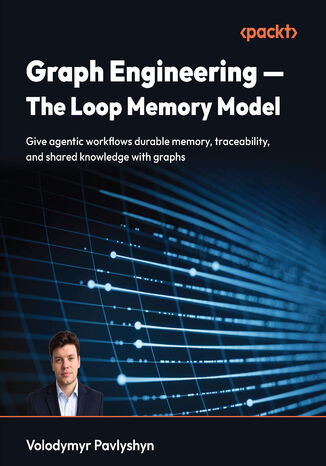
Graph Engineering -- The Loop Memory Model. Give agentic workflows durable memory, traceability, and shared knowledge with graphs
Volodymyr Pavlyshyn
Завантаження...
EЛЕКТРОННА КНИГА
Завантаження...
Agent loops are good at producing work, but the reasoning behind that work disappears the moment the context window closes. Two agents rediscover the same bug three sprints apart; a decision made in run 12 gets silently contradicted in run 47.
Graph Engineering moves that reasoning out of transcripts and into an explicit knowledge graph. You'll model execution history separately from durable knowledge, then connect the two with a small set of bridge relationships. Markdown stays the authoritative source; the graph is a disposable index built for queries, not a second source of truth.
From there, the book turns the model into a working mechanism: parse structured repository data, extract only genuine prose, resolve entities, and assemble typed relations. Retrieve small, relevant neighborhoods instead of dumping an entire knowledge base into context. See how evaluations check supporting paths, how concurrent workers publish changes without corrupting shared state, and how a pipeline preserves lineage from objective to artifact.
The final section is judgment; which metrics reveal graph quality, how false merges and bad incentives produce confident errors, what this architecture costs, and when a simple ADR log or relational table is the better answer.
- 1. Everyone's Building Loops, Almost Nobody's Building the One That Remembers
- 2. The Ladder: Five Architectures, Five Bottlenecks
- 3. Two Graphs, Not One
- 4. The Lattice You Already Have
- 5. Lattice Metagraphs
- 6. Semantic Spacetime for the Lattice
- 7. The Schema
- 8. Building the Graph
- 9. Context Assembly and the Grounded Evaluator
- 10. The Swarm Against One Graph
- 11. The Pipeline, Rewired
- 12. Metrics, Failure Modes, and When Not To Build This
- 13. The Build Path
- 14. Further Reading
- Назва:Graph Engineering -- The Loop Memory Model. Give agentic workflows durable memory, traceability, and shared knowledge with graphs
- Автор:Volodymyr Pavlyshyn
- Оригінальна назва:Graph Engineering -- The Loop Memory Model. Give agentic workflows durable memory, traceability, and shared knowledge with graphs
- ISBN:9781808812460, 9781808812460
- Дата видання:2026-10-19
- Формат:Eлектронна книга - EPUB
- Ідентифікатор видання: e_57rc
- Видавець: Packt Publishing
Завантаження...
Завантаження...