
Programowanie w chmurze
Robust Cloud integration with Azure. Unleash the power of serverless integration with Azure
Mahindra Morar, Abhishek Kumar, Martin Abbott, Gyanendra...
Any software developers, architects, and technical managers lookng to learn about Azure IaaS essentials need look no further. This book is ideal for Microsoft Enterprise developers, DevOps or any IT professionals looking to connect cloud-based and on-premises systems with Azure.
Johan Yu
Built on the Salesforce App Cloud, the new Lightning Experience combines the new Lightning Design System, Lightning App Builder, and Lightning Components to enable anyone to quickly and easily create modern enterprise apps.The book will start with a gentle introduction to the basics of Salesforce reports and dashboards. It will also explain how to access reports in depth. Then you will learn how to create and manage reports, to use Schedule Report, and create advanced report configurations. The next section talks about dashboards and will enable you to understand and compare various types of dashboard component and how you can benefit the most from each of them. Then we move on to advanced topics and explain tips and tricks related to reports and dashboards, including reporting snapshots, report parameters, and collaboration.Finally, we will discuss how to access dashboards and reports from the Salesforce1 mobile app.
Kerry Townsend
Salesforce Sales Cloud is a system rich in functionality, addressing many sales business challenges such as sales productivity, forecast visibility, and sales enablement. However, unlocking the full value of the system and getting maximum returns pose a challenge, especially if you’re new to the technology.This implementation handbook goes beyond mere configuration to ensure a successful implementation journey. From laying the groundwork for your project to engaging stakeholders with sales-specific business insights, this book equips you with the knowledge you need to plan and execute.As you progress, you’ll learn how to design a robust data model to support the sales and lead generation process, followed by crafting an intuitive user experience to drive productivity. You’ll then explore crucial post-building aspects such as testing, training, and releasing functionality. Finally, you’ll discover how the solutions’ capability can be expanded by adding and integrating other tools to address typical sales use cases.By the end of this book, you’ll have grasped how to leverage Sales Cloud to solve sales challenges and have gained the confidence to design and implement solutions successfully with the help of real-world use cases.
SAP on Azure Implementation Guide. Move your business data to the cloud
Nick Morgan, Bartosz Jarkowski
Cloud technologies have now reached a level where even the most critical business systems can run on them. For most organizations SAP is the key business system. If SAP is unavailable for any reason then potentially your business stops. Because of this, it is understandable that you will be concerned whether such a critical system can run in the public cloud. However, the days when you truly ran your IT system on-premises have long since gone. Most organizations have been getting rid of their own data centers and increasingly moving to co-location facilities. In this context the public cloud is nothing more than an additional virtual data center connected to your existing network.There are typically two main reasons why you may consider migrating SAP to Azure: You need to replace the infrastructure that is currently running SAP, or you want to migrate SAP to a new database. Depending on your goal SAP offers different migration paths. You can decide either to migrate the current workload to Azure as-is, or to combine it with changing the database and execute both activities as a single step. SAP on Azure Implementation Guide covers the main migration options to lead you through migrating your SAP data to Azure simply and successfully.
Ivan Nikolov
Design patterns make developers’ lives easier by helping them write great software that is easy to maintain, runs efficiently, and is valuable to the company or people concerned. You’ll learn about the various features of Scala and will be able to apply well-known, industry-proven design patterns in your work. The book starts off by focusing on some of the most interesting and latest features of Scala while using practical real-world examples. We will be learning about IDE’s and Aspect Oriented Programming. We will be looking into different components in Scala. We will also cover the popular Gang of Four design patterns and show you how to incorporate functional patterns effectively. The book ends with a practical example that demonstrates how the presented material can be combined in real-life applications. You’ll learn the necessary concepts to build enterprise-grade applications. By the end of this book, you’ll have enough knowledge and understanding to quickly assess problems and come up with elegant solutions.
Jason Myerscough
Azure Data Explorer (ADX) enables developers and data scientists to make data-driven business decisions. This book will help you rapidly explore and query your data at scale and secure your ADX clusters.The book begins by introducing you to ADX, its architecture, core features, and benefits. You'll learn how to securely deploy ADX instances and navigate through the ADX Web UI, cover data ingestion, and discover how to query and visualize your data using the powerful Kusto Query Language (KQL). Next, you'll get to grips with KQL operators and functions to efficiently query and explore your data, as well as perform time series analysis and search for anomalies and trends in your data. As you progress through the chapters, you'll explore advanced ADX topics, including deploying your ADX instances using Infrastructure as Code (IaC). The book also shows you how to manage your cluster performance and monthly ADX costs by handling cluster scaling and data retention periods. Finally, you'll understand how to secure your ADX environment by restricting access with best practices for improving your KQL query performance.By the end of this Azure book, you'll be able to securely deploy your own ADX instance, ingest data from multiple sources, rapidly query your data, and produce reports with KQL and Power BI.
Giovanni Galloro, David Dorbin, Richard Seroter, Nathaniel...
Continuous delivery, a cornerstone of modern software engineering, facilitates quick and secure software delivery using a robust toolkit encompassing automated builds, testing, source code management, artifact storage, and deployment. Whether you integrate tools from different providers or use a set of managed services from a single cloud provider, the goal is to streamline setup, integration, and management. This book focuses on continuous delivery on Google Cloud.Starting with an introduction to continuous delivery and secure software supply chain concepts, this book uses hands-on exercises to demonstrate how to continuously test your application with Skaffold and Cloud Code, leverage AI-assisted code generation with Cloud Code and Cloud Workstations, and automate your continuous integration with Cloud Build. You’ll see how to store and scan your software artifacts on Artifact Registry, orchestrate deployments with Cloud Deploy, and release your software on GKE and Cloud Run, configured to admit only trusted code. Using an example application, you’ll implement tools for creating an end-to-end delivery pipeline using Google Cloud services.By the end of this book, you’ll be able to build a secure software delivery pipeline from development to production using Google Cloud managed services and best practices.
IT Governance Publishing, Lee Newcombe
Cloud computing plays a critical role in modern business, but with it comes a host of security challenges. This book explores the intricacies of securing cloud services, starting with foundational concepts of cloud computing and moving into specific service and deployment models. It provides insights into balancing security benefits with potential risks such as availability issues, shadow IT, and information leakage. The book goes on to focus on security threats, from hackers and insiders to government entities, while offering strategies to mitigate these risks. The practical approach continues with a deep dive into security architecture, providing a structured model to secure cloud environments across IaaS, PaaS, SaaS, and more. Further, it examines the regulatory landscape, including compliance requirements, privacy concerns, and data protection laws that impact cloud service security. Finally, the book concludes with projections about the future of cloud security and emerging challenges. Readers will gain not only the theoretical foundations but also real-world insights that they can apply to strengthen their cloud service security.
Mohit Gupta
Serverless Architecture with AWS begins with an introduction to the serverless model and helps you get started with AWS and Lambda. You'll also get to grips with other capabilities of the AWS Serverless Platform and see how AWS supports enterprise-grade serverless applications with and without Lambda.This book will guide you in deploying your first serverless project and exploring the capabilities of serverless Amazon Athena, an interactive query service that makes it easy to analyze data in Amazon Simple Storage Service (S3 Amazon) using standard SQL. You’ll also learn about AWS Glue, a fully managed ETL service that makes categorizing data easy and cost-effective. You'll study how Amazon Kinesis makes it possible to unleash the potential of real-time data insights and analytics with capabilities such as video streams, data streams, data firehose, and data analytics. Last but not least, you’ll be equipped to combine Amazon Kinesis capabilities with AWS Lambda to create lightweight serverless architectures.By the end of the book, you will be ready to create and run your first serverless application that takes advantage of the high availability, security, performance, and scalability of AWS.
Abhishek Kumar, Srinivasa Mahendrakar
With more enterprises adapting cloud-based and API-based solutions, application integration has become more relevant and significant than ever before. Parallelly, Serverless Integration has gained popularity, as it helps agile organizations to build integration solutions quickly without having to worry about infrastructure costs. With Microsoft Azure’s serverless offerings, such as Logic Apps, Azure Functions, API Management, Azure Event Grid and Service Bus, organizations can build powerful, secure, and scalable integration solutions with ease.The primary objective of this book is to help you to understand various serverless offerings included within Azure Integration Services, taking you through the basics and industry practices and patterns. This book starts by explaining the concepts of services such as Azure Functions, Logic Apps, and Service Bus with hands-on examples and use cases. After getting to grips with the basics, you will be introduced to API Management and building B2B solutions using Logic Apps Enterprise Integration Pack.This book will help readers to understand building hybrid integration solutions and touches upon Microsoft Cognitive Services and leveraging them in modern integration solutions. Industry practices and patterns are brought to light at appropriate opportunities while explaining various concepts.
Serverless na platformie Azure
Zbigniew Fryźlewicz, Dariusz Parzygnat, Łukasz Przerada
Odkryj platformę Microsoft Azure i możliwości architektury serverless! Poznaj usługi FaaS oferowane przez platformę Azure Twórz skalowalne aplikacje w architekturze serverless Naucz się praktycznie wykorzystywać potencjał chmury Platformy chmurowe i oferowane przez nie usługi zdobyły serca całych rzesz programistów i inwestorów IT, którzy cenią sobie nie tylko ich wysoką skalowalność, niezawodność i bezpieczeństwo, lecz również stosunkowo niskie koszty, wygodę używania oraz możliwości szybkiego uruchamiania i udostępniania gotowych rozwiązań. Ostatnimi czasy szczególnie popularna jest architektura serverless, dzięki której tworzenie i wdrażanie wydajnych aplikacji sieciowych wymaga niewielkich nakładów pracy i jest możliwe w bardzo krótkim czasie. Jeśli chcesz od praktycznej strony poznać proces budowania i wdrażania aplikacji wykorzystującej usługi FaaS oferowane przez chmurę firmy Microsoft, sięgnij po książkę Serverless na platformie Azure. Bez zbędnych wstępów otworzy przed Tobą świat nowoczesnej architektury, umożliwiającej szybkie i łatwe wprowadzanie na rynek wydajnych, skalowalnych i łatwych w utrzymaniu aplikacji biznesowych. Dzięki lekturze poznasz kroki niezbędne do opracowania rozwiązania opartego na Azure Functions, realizacji przepływów za pomocą Durable Task Framework i integracji aplikacji z zewnętrznymi serwisami przy użyciu Azure Logic Apps. Dowiesz się też, jak monitorować rozwiązanie za pomocą usługi Application Insights. Zalety i ograniczenia architektury i przetwarzania serverless Tworzenie aplikacji opartej na Azure Functions Realizacja przepływów za pomocą Durable Functions Integracja z zewnętrznymi serwisami przy użyciu Azure Logic Apps Wdrożenie aplikacji za pomocą narzędzi CI/CD w ramach usługi Azure DevOps Testowanie aplikacji opartej na Azure Functions Monitorowanie rozwiązania za pomocą Application Insights Buduj, wdrażaj, oszczędzaj - pracuj wydajniej dzięki architekturze serverless!
Heartin Kanikathottu
Managing physical servers will be a thing of the past once you’re able to harness the power of serverless computing. If you’re already prepped with the basics of serverless computing, Serverless Programming Cookbook will help you take the next step ahead. This recipe-based guide provides solutions to problems you might face while building serverless applications. You'll begin by setting up Amazon Web Services (AWS), the primary cloud provider used for most recipes. The next set of recipes will cover various components to build a Serverless application including REST APIs, database, user management, authentication, web hosting, domain registration, DNS management, CDN, messaging, notifications and monitoring. The book also introduces you to the latest technology trends such as Data Streams, Machine Learning and NLP. You will also see patterns and practices for using various services in a real world application. Finally, to broaden your understanding of Serverless computing, you'll also cover getting started guides for other cloud providers such as Azure, Google Cloud Platform and IBM cloud. By the end of this book, you’ll have acquired the skills you need to build serverless applications efficiently using various cloud offerings.
ServiceNow Application Development. Transform the way you build apps for enterprises
Sagar Gupta
ServiceNow provides service management for every department in the enterprise, including IT, Human Resources, Facilities, Field Service, and more.This book focuses on all the steps required to develop apps and workflows for any of your business requirements using ServiceNow. You will start with the first module, which covers the basics of ServiceNow and how applications are structured; how you can customize the dashboard as required; and also how to create users. After you get used to the dashboard, you will move on to the next module, Applications and Tables, where you will learn about working with different tables and how you can create a scope other than the global scope for your application. The next module is Scripting and APIs, where you will learn Scripting in ServiceNow and use powerful APIs to develop applications. The final module, Administration Essentials, covers debugging, advanced database features, and scheduled script creation.By the end of the book you will have mastered creating organized and customer-friendly applications
ServiceNow IT Operations Management. Demystifying IT Operations Management
Ajaykumar Guggilla, Andrew Pishchulin
ServiceNow ITOM enables infrastructure and processes to be managed in a highly automated manner. It contains various segments that ensure its applications and enterprise infrastructures are optimized for high performance and helps in creating a lean and agile organization through service?level visibility and automation.This book will be a comprehensive guide that will be based on Geneva release and will help you discover how IT activities can be connected to your business needs, rather than just focusing on internal IT process. It will take a service-centric approach to operations management and consolidate all your resource data into a single system IT record. You will learn about discovery, orchestration, MID server and cloud management, helping you take full advantage of ServiceNow IT Operations Management to improve the quality of service & increasing the service availability.By the end of the book, you will be able to achieve improved service availability, immediate visibility of vital business services and much more, all from the convenience of your single screen.
Sakti Mishra
Amazon EMR, formerly Amazon Elastic MapReduce, provides a managed Hadoop cluster in Amazon Web Services (AWS) that you can use to implement batch or streaming data pipelines. By gaining expertise in Amazon EMR, you can design and implement data analytics pipelines with persistent or transient EMR clusters in AWS.This book is a practical guide to Amazon EMR for building data pipelines. You'll start by understanding the Amazon EMR architecture, cluster nodes, features, and deployment options, along with their pricing. Next, the book covers the various big data applications that EMR supports. You'll then focus on the advanced configuration of EMR applications, hardware, networking, security, troubleshooting, logging, and the different SDKs and APIs it provides. Later chapters will show you how to implement common Amazon EMR use cases, including batch ETL with Spark, real-time streaming with Spark Streaming, and handling UPSERT in S3 Data Lake with Apache Hudi. Finally, you'll orchestrate your EMR jobs and strategize on-premises Hadoop cluster migration to EMR. In addition to this, you'll explore best practices and cost optimization techniques while implementing your data analytics pipeline in EMR.By the end of this book, you'll be able to build and deploy Hadoop- or Spark-based apps on Amazon EMR and also migrate your existing on-premises Hadoop workloads to AWS.
Alexandra F. McCoy
In today's digital landscape, ensuring service reliability is more than just a necessity—it’s a competitive advantage. SLIs and SLOs Demystified equips software engineers, SREs, and business leaders with the knowledge to build, measure, and manage service level indicators (SLIs) and service level objectives (SLOs) efficiently. Written by Alexandra F. McCoy—an experienced site reliability engineer with over a decade of experience in the cloud and technology industry—this book simplifies complex reliability concepts for engineers at all levels. Starting with a review of reliability engineering basics, Alexandra provides a step-by-step approach to defining impactful SLIs, facilitating productive SLO discussions, and integrating observability into your monitoring strategy. You'll also see how these principles apply to web applications, distributed systems, databases, and new features through real-world examples that can help you develop SLIs and SLOs for your specific environment. The book goes beyond implementation to explore the financial impact of reliability, alerting strategies, integration with incident management, and using error budgets for business decisions.By the end of this book, you’ll be able to drive operational excellence, minimize unplanned downtime, and optimize end user experiences with well-established reliability metrics.
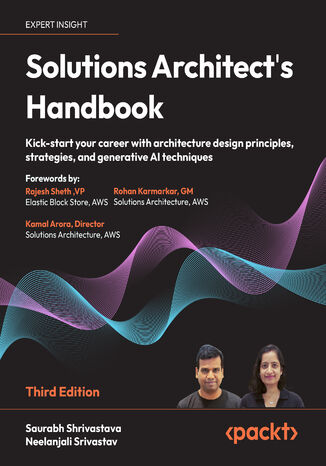
Saurabh Shrivastava, Neelanjali Srivastav, Rajesh Sheth, Kamal...
Build a strong foundation in solution architecture and excel in your career with the Solutions Architect’s Handbook. Authored by seasoned AWS technology leaders Saurabh Shrivastav and Neelanjali Srivastav, this book goes beyond traditional certification guides, offering in-depth insights and advanced techniques to meet the specific needs and challenges of solutions architects today. This edition introduces exciting new features that keep you at the forefront of this evolving field. From large language models and generative AI to deep learning innovations, these cutting-edge advancements are shaping the future of technology. Key topics such as cloud-native architecture, data engineering architecture, cloud optimization, mainframe modernization, and building cost-efficient, secure architectures remain essential today. This book covers both emerging and foundational technologies, guiding you through solution architecture design with key principles and providing the knowledge you need to succeed as a Solutions Architect. It also sharpens your soft skills, providing career-accelerating techniques to stay ahead.By the end of this book, you will be able to harness cutting-edge technologies, apply practical insights from real-world scenarios, and enhance your solution architecture skills with the Solutions Architect's Handbook.
Saurabh Shrivastava, Neelanjali Srivastav
Becoming a solutions architect gives you the flexibility to work with cutting-edge technologies and define product strategies. This handbook takes you through the essential concepts, design principles and patterns, architectural considerations, and all the latest technology that you need to know to become a successful solutions architect.This book starts with a quick introduction to the fundamentals of solution architecture design principles and attributes that will assist you in understanding how solution architecture benefits software projects across enterprises. You'll learn what a cloud migration and application modernization framework looks like, and will use microservices, event-driven, cache-based, and serverless patterns to design robust architectures. You'll then explore the main pillars of architecture design, including performance, scalability, cost optimization, security, operational excellence, and DevOps. Additionally, you'll also learn advanced concepts relating to big data, machine learning, and the Internet of Things (IoT). Finally, you'll get to grips with the documentation of architecture design and the soft skills that are necessary to become a better solutions architect.By the end of this book, you'll have learned techniques to create an efficient architecture design that meets your business requirements.
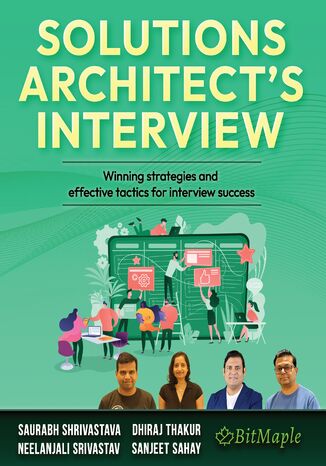
Solutions Architect's Interview. Winning strategies and effective tactics for interview success
Saurabh Shrivastava, Neelanjali Srivastav, Dhiraj Thakur, Sanjeet...
The Solutions Architect role sits at the intersection of technology, business strategy, and communication. Excelling in it takes more than technical expertise—it demands architectural thinking, leadership, and problem-solving skills. This book guides you in achieving this balance, walking you through every stage of becoming a Solutions Architect.It begins by unpacking what the role truly involves and then progresses into the nuances of interview preparation across multiple domains. You’ll learn how to structure your responses to scenario-based questions, highlight both your technical proficiency and soft skills, and position yourself as a strategic problem solver. Each chapter offers practical exercises, frameworks, and real interview examples that help you build the confidence and insight to stand out. The final chapter guides you through your first 90 days as a new Solutions Architect, aligning with business goals, understanding organizational architecture, and building credibility.By the end of this book, you’ll have the technical, behavioral, and strategic foundation to ace your interviews and thrive in any Solutions Architect role.
Joey D'Antoni, Louis Davidson, Allan Hirt ,...
Deploying SQL Server on Azure virtual machines allows you to work on full versions of SQL Server in the cloud without having to maintain on-premises hardware. The book begins by introducing you to the SQL portfolio in Azure and takes you through SQL Server IaaS scenarios, before explaining the factors that you need to consider while choosing an OS for SQL Server in Azure VMs. As you progress through the book, you'll explore different VM options and deployment choices for IaaS and understand platform availability, migration tools, and best practices in Azure. In later chapters, you'll learn how to configure storage to achieve optimized performance. Finally, you'll get to grips with the concept of Azure Hybrid Benefit and find out how you can use it to maximize the value of your existing on-premises SQL Server.By the end of this book, you'll be proficient in administering SQL Server on Microsoft Azure and leveraging the tools required for its deployment.
Anindita Basak, Krishnaswamy Venkataraman, Ryan Murphy, Manpreet...
Microsoft Azure is a very popular cloud computing service used by many organizations around the world. Its latest analytics offering, Stream Analytics, allows you to process and get actionable insights from different kinds of data in real-time. This book is your guide to understanding the basics of how Azure Stream Analytics works, and building your own analytics solution using its capabilities. You will start with understanding what Stream Analytics is, and why it is a popular choice for getting real-time insights from data. Then, you will be introduced to Azure Stream Analytics, and see how you can use the tools and functions in Azure to develop your own Streaming Analytics. Over the course of the book, you will be given comparative analytic guidance on using Azure Streaming with other Microsoft Data Platform resources such as Big Data Lambda Architecture integration for real time data analysis and differences of scenarios for architecture designing with Azure HDInsight Hadoop clusters with Storm or Stream Analytics. The book also shows you how you can manage, monitor, and scale your solution for optimal performance.By the end of this book, you will be well-versed in using Azure Stream Analytics to develop an efficient analytics solution that can work with any type of data.
Sustainable Cloud Development. Optimize cloud workloads for environmental impact in the GenAI era
Parth Girish Patel, Ishneet Kaur Dua, Steven...
Written by three seasoned AWS solution architects, sustainability mentors, and thought leaders, Sustainable Cloud Development equips cloud professionals with actionable strategies to design, build, and optimize workloads that minimize environmental impact, while maintaining performance and scalability.This book combines practical insights, best practices, and case studies to help you align your cloud operations with global sustainability goals. From foundational concepts such as carbon footprint measurement to advanced techniques such as sustainable software architecture, generative AI lifecycle optimization, and cost-efficient cloud practices, this book covers every aspect of sustainable cloud development. You’ll get to grips with key tools, including AWS Cost Explorer, for analyzing costs and usage over time to right-size deployments; auto scaling for automatically scaling compute resources dynamically based on demand; Amazon Trusted Advisor for reviewing optimization recommendations across critical areas such as cost, performance, and security; and Amazon CloudWatch for detailed monitoring and threshold-based alerting around all resources and applications.This book serves as a practical blueprint for optimizing your cloud workloads for both high performance and a minimal environmental footprint.
Edvaldo Alessandro Cardoso Sobrinho, EDVALDO ALESSANDRO CARDOSO
This book is a step-by-step guide packed with recipes that cover architecture design and planning. The book is also full of deployment tips, techniques, and solutions.If you are a solutions architect, technical consultant, administrator, or any other virtualization enthusiast who needs to use Microsoft System Center Virtual Machine Manager in a real-world environment, then this is the book for you.We assume that you have previous experience with Windows 2012 R2 and Hyper-V.
Roman Levchenko, EDVALDO ALESSANDRO CARDOSO
Virtual Machine Manager (VMM) 2016 is part of the System Center suite to configure and manage datacenters and offers a unified management experience on-premises and Azure cloud.This book will be your best companion for day-to-day virtualization needs within your organization, as it takes you through a series of recipes to simplify and plan a highly scalable and available virtual infrastructure. You will learn the deployment tips, techniques, and solutions designed to show users how to improve VMM 2016 in a real-world scenario. The chapters are divided in a way that will allow you to implement the VMM 2016 and additional solutions required to effectively manage and monitor your fabrics and clouds. We will cover the most important new features in VMM 2016 across networking, storage, and compute, including brand new Guarded Fabric, Shielded VMs and Storage Spaces Direct. The recipes in the book provide step-by-step instructions giving you the simplest way to dive into VMM fabric concepts, private cloud, and integration with external solutions such as VMware, Operations Manager, and the Windows Azure Pack.By the end of this book, you will be armed with the knowledge you require to start designing and implementing virtual infrastructures in VMM 2016.