
Verleger: Packt Publishing
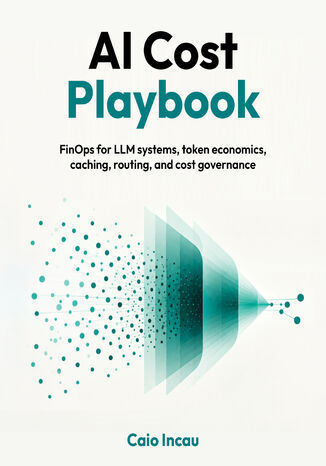
AI Cost Playbook. FinOps for LLM systems, token economics, caching, routing, and cost governance
Caio Incau
LLM applications introduce a new kind of cloud economics. Costs are usage-based, model-dependent, and influenced by everything from prompt length and caching to RAG pipelines and autonomous agent loops. As grows, engineering teams need more than isolated cost-cutting tricks; they need FinOps for LLM systems.The AI Cost Playbook shows you how to apply financial accountability and engineering discipline to production AI. You’ll build tokenwatch, a Python-based cost observability and optimization toolkit, while learning to meter tokens, attribute spend, and calculate costs per request, user, and feature.You’ll then reduce unnecessary spend through prompt optimization, caching, batch processing, model routing and cascades, RAG optimization, and agent cost controls. You’ll also evaluate the break-even economics of self-hosting and learn how to forecast future AI expenditure.Finally, you’ll turn optimization into an operating discipline by establishing budgets, quotas, forecasting, and cost accountability. With configurable pricing rather than hardcoded model costs, the techniques remain useful as providers, models, and pricing evolve.
Hadelin de Ponteves
Welcome to the Robot World … and start building intelligent software now!Through his best-selling video courses, Hadelin de Ponteves has taught hundreds of thousands of people to write AI software. Now, for the first time, his hands-on, energetic approach is available as a book. Starting with the basics before easing you into more complicated formulas and notation, AI Crash Course gives you everything you need to build AI systems with reinforcement learning and deep learning. Five full working projects put the ideas into action, showing step-by-step how to build intelligent software using the best and easiest tools for AI programming, including Python, TensorFlow, Keras, and PyTorch.AI Crash Course teaches everyone to build an AI to work in their applications. Once you've read this book, you're only limited by your imagination.

Walid SASSI, Dave Poirier, Jon Reid
AI isn’t replacing engineers, it’s developers collaborating with intelligent tools to build stronger, safer, and more maintainable applications. AI Driven Swift Architecture is your practical guide to help intermediate and senior iOS developers confidently embrace the next era of Apple development.This book takes you on an unfiltered journey into modern Swift development with Swift 6 concurrency, SwiftUI, and Clean Architecture at its core. You’ll learn how Claude Code and advanced AI assistants can accelerate feature development, improve architectural decision-making, and transform testing into a collaborative workflow.You will explore Apple’s new on-device foundation models for private, offline intelligence and put the Model Context Protocol (MCP) into practice by building custom MCP servers in Swift. From AI-powered legacy modernization to governance workflows with Request for Comments and Architecture Decision Record, every chapter focuses on real code, real patterns, and real outcomes.Whether you’re modernizing existing UIKit systems or designing scalable SwiftUI architectures from scratch, this book will offer you a repeatable workflow for shipping future ready iOS apps feature by feature, agent by agent, and test by test.
Laura Miller
The rapid rise of GenAI has led businesses to engage in discussions about ethical innovation, but these discussions often lack clear, practical guidance. AI Ethics in Action fills this gap with practical, actionable guidance from an award-winning ethicist and founder and CEO of Aeterne.This book begins by laying a foundation in philosophical ethics, exploring the ethics of artificial intelligence before setting out a framework for responsible AI innovation, and offering strategies for measurable, ethical decision-making. The chapters provide practical advice on navigating the complex regulatory landscape that organizations, especially global ones, face. You’ll be prepared for the inevitable disruptions AI will bring, with emphasis on the need for next-generation ethical considerations. You’ll also discover best practices and receive practical advice through an in-depth examination of lessons learned across various industries. This book also critically examines the expectations placed on those who develop and deploy AI, addressing the challenges of moving beyond the pursuit of perfection.By the end of this book, you’ll be able to apply ethical frameworks to AI systems, tackle complex challenges, and make responsible decisions that build trust, transparency, and positive societal impact across your organization and the world.
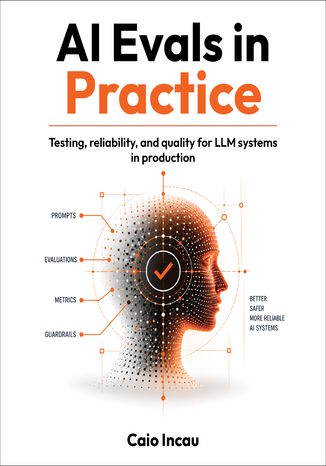
AI Evals in Practice. Testing, reliability, and quality for LLM systems in production
Caio Incau
LLM applications can look healthy in dashboards while their answers quietly become less accurate, less useful, or less reliable. AI Evals in Practice gives developers and AI engineers a systematic way to measure quality, catch regressions, and make evidence-based improvements before and after deployment.You will build evalkit, a complete Python evaluation harness, while learning the core components of an eval: datasets, scorers, runners, and golden test sets. You will create deterministic scorers and LLM-as-judge evaluations, then calibrate judges and mitigate common biases. The book applies these foundations to prompt regression testing and CI, RAG retrieval and generation metrics, agent trajectories and tool calls, and human annotation workflows. You will then extend evaluation into production with online sampling, guardrails, and cost- and latency-aware pipelines, while comparing tools such as DeepEval, promptfoo, Langfuse, and Braintrust. A case study and final project bring the pieces together into an eval-driven development workflow with CI and a dashboard.By the end, you will be able to design evaluation pipelines that help you ship LLM systems with measurable, repeatable quality.
AI Explained. Uncovering the Reality, Risks, and Rewards of Artificial Intelligence
Nigel Poulton
This book leads readers on a comprehensive journey through artificial intelligence, beginning with an introduction to its foundational concepts. Early on, readers are guided through what AI is and why it’s becoming a transformative force in today’s world. They’ll then explore the technical processes behind AI creation, learning how data and algorithms power intelligent systems, making complex technology accessible and understandable.Further on, the book delves into practical applications and ethical considerations. Readers discover the positive ways AI is improving our lives, from breakthroughs in healthcare to innovations in everyday industries. Following this, it presents a balanced view of AI’s potential risks, discussing the ethical concerns and societal challenges that arise with misuse, encouraging thoughtful reflection on AI’s impact.Towards the end, the book tackles critical future challenges and solutions. It discusses the threat of rogue AI behaviors and highlights strategies to prevent AI from acting unpredictably. The final section offers an optimistic outlook on the responsible development of AI, encouraging readers to envision a future where AI can drive positive change. By journey’s end, readers will feel equipped with a nuanced understanding of AI, its real-world significance, and its ethical implications.
Oliver Theobald
The course begins with an engaging introduction to the world of Artificial Intelligence, making it approachable for absolute beginners. We unravel the mysteries of AI's evolution, from its historical roots to the cutting-edge technologies shaping our future. By explaining complex concepts in simple terms, this course aims to illuminate the path for those curious about how AI impacts our world.The course focuses on the core components of AI, including machine learning, deep learning, and natural language processing, before advancing to more specialized topics like generative AI and computer vision. Each module is designed to build a comprehensive understanding, emphasizing why these technologies are crucial for solving real-world problems and how they're transforming industries.The course wraps up by exploring the ethical considerations and privacy concerns associated with AI, along with a visionary look at the future of work in an AI-driven world. It offers a treasure trove of further resources, ensuring learners have everything they need to continue their exploration of AI.

Oliver Theobald, Alan Turton
Embark on a journey through the fascinating world of artificial intelligence, designed for individuals with no technical background. This audiobook is tailored for marketers, entrepreneurs, students, and professionals who want to engage with AI from a practical and ethical standpoint, without diving into complex algorithms or coding. The audiobook begins with an exploration of AI fundamentals, providing a clear and approachable foundation of concepts, terminology, and real-world applications.As you progress, you'll encounter practical thought experiments designed to make AI's impact more tangible. Each chapter carefully guides you through essential topics such as machine learning, deep learning, and natural language processing, focusing on how these technologies are already affecting industries today. You’ll also explore the ethical implications of AI, understanding how privacy and fairness come into play when designing AI solutions.By the end of this course, you’ll be equipped with the knowledge to participate in crucial discussions and decision-making processes regarding AI in your organization or daily life. This audiobookis ideal for those who want to build a solid understanding of AI without the need for technical expertise, empowering you to think critically and responsibly about AI’s future.