
Big data
Dmitrijs Cudihins
Hands-On Computer Vision with Julia is a thorough guide for developers who want to get started with building computer vision applications using Julia. Julia is well suited to image processing because it’s easy to use and lets you write easy-to-compile and efficient machine code..This book begins by introducing you to Julia's image processing libraries such as Images.jl and ImageCore.jl. You’ll get to grips with analyzing and transforming images using JuliaImages; some of the techniques discussed include enhancing and adjusting images. As you make your way through the chapters, you’ll learn how to classify images, cluster them, and apply neural networks to solve computer vision problems. In the concluding chapters, you will explore OpenCV applications to perform real-time computer vision analysis, for example, face detection and object tracking. You will also understand Julia's interaction with Tesseract to perform optical character recognition and build an application that brings together all the techniques we introduced previously to consolidate the concepts learned.By end of the book, you will have understood how to utilize various Julia packages and a few open source libraries such as Tesseract and OpenCV to solve computer vision problems with ease.
Iffat Zafar, Giounona Tzanidou, Richard Burton, Nimesh...
Convolutional Neural Networks (CNN) are one of the most popular architectures used in computer vision apps. This book is an introduction to CNNs through solving real-world problems in deep learning while teaching you their implementation in popular Python library - TensorFlow. By the end of the book, you will be training CNNs in no time!We start with an overview of popular machine learning and deep learning models, and then get you set up with a TensorFlow development environment. This environment is the basis for implementing and training deep learning models in later chapters. Then, you will use Convolutional Neural Networks to work on problems such as image classification, object detection, and semantic segmentation.After that, you will use transfer learning to see how these models can solve other deep learning problems. You will also get a taste of implementing generative models such as autoencoders and generative adversarial networks.Later on, you will see useful tips on machine learning best practices and troubleshooting. Finally, you will learn how to apply your models on large datasets of millions of images.
Rajneesh Gupta
Blockchain technology is being welcomed as one of the most revolutionary and impactful innovations of today. Blockchain technology was first identified in the world’s most popular digital currency, Bitcoin, but has now changed the outlook of several organizations and empowered them to use it even for storage and transfer of value.This book will start by introducing you to the common cyberthreat landscape and common attacks such as malware, phishing, insider threats, and DDoS. The next set of chapters will help you to understand the workings of Blockchain technology, Ethereum and Hyperledger architecture and how they fit into the cybersecurity ecosystem. These chapters will also help you to write your first distributed application on Ethereum Blockchain and the Hyperledger Fabric framework. Later, you will learn about the security triad and its adaptation with Blockchain. The last set of chapters will take you through the core concepts of cybersecurity, such as DDoS protection, PKI-based identity, 2FA, and DNS security. You will learn how Blockchain plays a crucial role in transforming cybersecurity solutions.Toward the end of the book, you will also encounter some real-world deployment examples of Blockchain in security cases, and also understand the short-term challenges and future of cybersecurity with Blockchain.
Abhishek Agarwal
QlikView is one of the market leaders when it comes to building effective Business Intelligence solutions. This book will show how you can leverage its power to build your own dashboards to tell your own data story.The book starts with showing you how to connect your data to QlikView and create your own QlikView application. You will learn how to add data from multiple sources, create a data model by joining data, and then review it on the front end. You will work with QlikView components such as charts, list boxes, input boxes, and text objects to create stunning visualizations that help give actionable business insights. You will also learn how to perform analysis on your data in QlikView and master the various types of security measures to be taken in QlikView.By the end of this book, you will have all the essential knowledge required for insightful data storytelling and creating useful BI dashboards using QlikView.
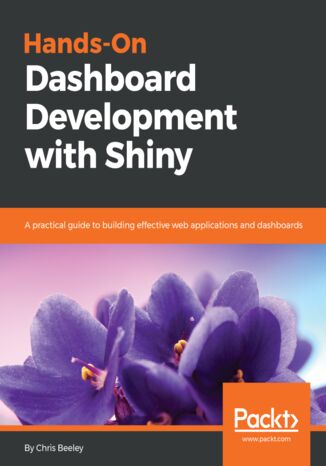
Chris Beeley
Although vanilla Shiny applications look attractive with some layout flexibility, you may still want to have more control over how the interface is laid out to produce a dashboard. Hands-On Dashboard Development with Shiny helps you incorporate this in your applications.The book starts by guiding you in producing an application based on the diamonds dataset included in the ggplot2 package. You’ll create a single application, but the interface will be reskinned and rebuilt throughout using different methods to illustrate their uses and functions using HTML, CSS, and JavaScript. You will also learn to develop an application that creates documents and reports using R Markdown. Furthermore, the book demonstrates the use of HTML templates and the Bootstrap framework. Moving along, you will learn how to produce dashboards using the Shiny command and dashboard package. Finally, you will learn how to lay out applications using a wide range of built-in functions.By the end of the book, you will have an understanding of the principles that underpin layout in Shiny applications, including sections of HTML added to a vanilla Shiny application, HTML interfaces written from scratch, dashboards, navigation bars, and interfaces.
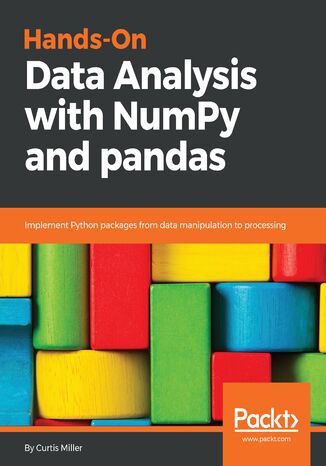
Curtis Miller
Python, a multi-paradigm programming language, has become the language of choice for data scientists for visualization, data analysis, and machine learning.Hands-On Data Analysis with NumPy and Pandas starts by guiding you in setting up the right environment for data analysis with Python, along with helping you install the correct Python distribution. In addition to this, you will work with the Jupyter notebook and set up a database. Once you have covered Jupyter, you will dig deep into Python’s NumPy package, a powerful extension with advanced mathematical functions. You will then move on to creating NumPy arrays and employing different array methods and functions. You will explore Python’s pandas extension which will help you get to grips with data mining and learn to subset your data. Last but not the least you will grasp how to manage your datasets by sorting and ranking them. By the end of this book, you will have learned to index and group your data for sophisticated data analysis and manipulation.
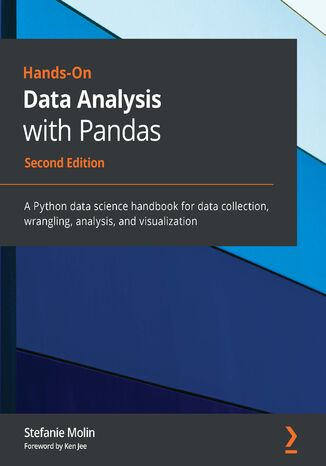
Stefanie Molin
Extracting valuable business insights is no longer a ‘nice-to-have’, but an essential skill for anyone who handles data in their enterprise. Hands-On Data Analysis with Pandas is here to help beginners and those who are migrating their skills into data science get up to speed in no time.This book will show you how to analyze your data, get started with machine learning, and work effectively with the Python libraries often used for data science, such as pandas, NumPy, matplotlib, seaborn, and scikit-learn.Using real-world datasets, you will learn how to use the pandas library to perform data wrangling to reshape, clean, and aggregate your data. Then, you will learn how to conduct exploratory data analysis by calculating summary statistics and visualizing the data to find patterns. In the concluding chapters, you will explore some applications of anomaly detection, regression, clustering, and classification using scikit-learn to make predictions based on past data.This updated edition will equip you with the skills you need to use pandas 1.x to efficiently perform various data manipulation tasks, reliably reproduce analyses, and visualize your data for effective decision making – valuable knowledge that can be applied across multiple domains.
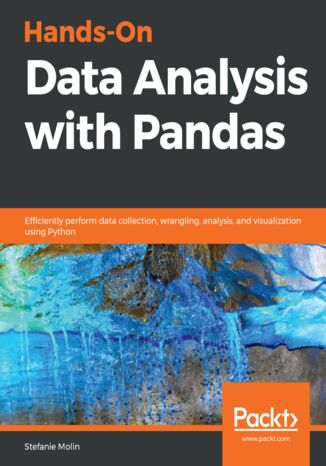
Stefanie Molin
Data analysis has become a necessary skill in a variety of domains where knowing how to work with data and extract insights can generate significant value.Hands-On Data Analysis with Pandas will show you how to analyze your data, get started with machine learning, and work effectively with Python libraries often used for data science, such as pandas, NumPy, matplotlib, seaborn, and scikit-learn. Using real-world datasets, you will learn how to use the powerful pandas library to perform data wrangling to reshape, clean, and aggregate your data. Then, you will be able to conduct exploratory data analysis by calculating summary statistics and visualizing the data to find patterns. In the concluding chapters, you will explore some applications of anomaly detection, regression, clustering, and classification using scikit-learn to make predictions based on past data.By the end of this book, you will be equipped with the skills you need to use pandas to ensure the veracity of your data, visualize it for effective decision-making, and reliably reproduce analyses across multiple datasets.