
Big data
Financial Modelling using Dynamic Arrays. Let Lambdas Extend Your Range
MrExcel's Holy Macro! Books, Liam Bastick
Dive into the transformative power of Excel's dynamic arrays in financial modelling. Learn to optimize formulas with LET, create reusable LAMBDA functions, and craft sophisticated models. The book provides a comprehensive introduction to Excel’s dynamic arrays, comparing legacy methodologies with modern capabilities while integrating practical tips and best practices.Through real-world examples and step-by-step tutorials, you’ll uncover the full potential of functions like SORT, FILTER, SEQUENCE, and LAMBDA. Discover how dynamic arrays reduce errors, boost efficiency, and enable innovative approaches to financial modelling. The book also highlights advanced features like eta lambdas and helper functions, offering a deep dive into the cutting-edge tools now available in Excel 365.Whether you’re building complex financial models or just looking to refine your techniques, this guide equips you with the knowledge to transform your processes. Excel enthusiasts and professionals alike will appreciate the clarity and depth this book provides, helping you elevate your modelling game to a whole new level.
Frank Kane
Frank Kane’s Taming Big Data with Apache Spark and Python is your companion to learning Apache Spark in a hands-on manner. Frank will start you off by teaching you how to set up Spark on a single system or on a cluster, and you’ll soon move on to analyzing large data sets using Spark RDD, and developing and running effective Spark jobs quickly using Python.Apache Spark has emerged as the next big thing in the Big Data domain – quickly rising from an ascending technology to an established superstar in just a matter of years. Spark allows you to quickly extract actionable insights from large amounts of data, on a real-time basis, making it an essential tool in many modern businesses. Frank has packed this book with over 15 interactive, fun-filled examples relevant to the real world, and he will empower you to understand the Spark ecosystem and implement production-grade real-time Spark projects with ease.
Fundamentals of Analytics Engineering. An introduction to building end-to-end analytics solutions
Dumky De Wilde, Fanny Kassapian, Jovan Gligorevic,...
Written by a team of 7 industry experts, Fundamentals of Analytics Engineering will introduce you to everything from foundational concepts to advanced skills to get started as an analytics engineer.After conquering data ingestion and techniques for data quality and scalability, you’ll learn about techniques such as data cleaning transformation, data modeling, SQL query optimization and reuse, and serving data across different platforms. Armed with this knowledge, you will implement a simple data platform from ingestion to visualization, using tools like Airbyte Cloud, Google BigQuery, dbt, and Tableau. You’ll also get to grips with strategies for data integrity with a focus on data quality and observability, along with collaborative coding practices like version control with Git. You’ll learn about advanced principles like CI/CD, automating workflows, gathering, scoping, and documenting business requirements, as well as data governance.By the end of this book, you’ll be armed with the essential techniques and best practices for developing scalable analytics solutions from end to end.
Josh Kalin
Developing Generative Adversarial Networks (GANs) is a complex task, and it is often hard to find code that is easy to understand.This book leads you through eight different examples of modern GAN implementations, including CycleGAN, simGAN, DCGAN, and 2D image to 3D model generation. Each chapter contains useful recipes to build on a common architecture in Python, TensorFlow and Keras to explore increasingly difficult GAN architectures in an easy-to-read format. The book starts by covering the different types of GAN architecture to help you understand how the model works. This book also contains intuitive recipes to help you work with use cases involving DCGAN, Pix2Pix, and so on. To understand these complex applications, you will take different real-world data sets and put them to use.By the end of this book, you will be equipped to deal with the challenges and issues that you may face while working with GAN models, thanks to easy-to-follow code solutions that you can implement right away.
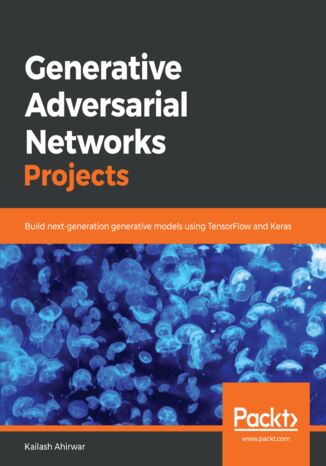
Kailash Ahirwar
Generative Adversarial Networks (GANs) have the potential to build next-generation models, as they can mimic any distribution of data. Major research and development work is being undertaken in this field since it is one of the rapidly growing areas of machine learning. This book will test unsupervised techniques for training neural networks as you build seven end-to-end projects in the GAN domain.Generative Adversarial Network Projects begins by covering the concepts, tools, and libraries that you will use to build efficient projects. You will also use a variety of datasets for the different projects covered in the book. The level of complexity of the operations required increases with every chapter, helping you get to grips with using GANs. You will cover popular approaches such as 3D-GAN, DCGAN, StackGAN, and CycleGAN, and you’ll gain an understanding of the architecture and functioning of generative models through their practical implementation.By the end of this book, you will be ready to build, train, and optimize your own end-to-end GAN models at work or in your own projects.
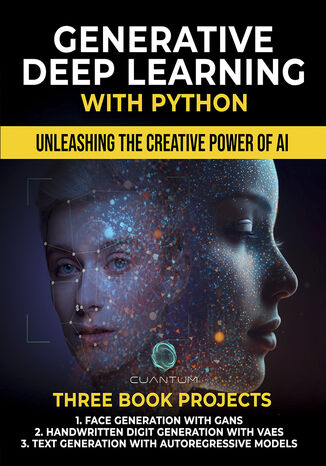
Generative Deep Learning with Python. Unleashing the Creative Power of AI by Mastering AI and Python
Cuantum Technologies LLC
Generative Deep Learning with Python opens the door to the fascinating world of AI where machines create. This course begins with an introduction to deep learning, establishing the essential concepts and techniques. You will then delve into generative models, exploring their theoretical foundations and practical applications. As you progress, you will gain a deep understanding of Generative Adversarial Networks (GANs), learning how they function and how to implement them for tasks like face generation.The course's hands-on projects, such as creating GANs for face generation and using Variational Autoencoders (VAEs) for handwritten digit generation, provide practical experience that reinforces your learning. You'll also explore autoregressive models for text generation, allowing you to see the versatility of generative models across different types of data. Advanced topics will prepare you for cutting-edge developments in the field.Throughout your journey, you will gain insights into the future landscape of generative deep learning, equipping you with the skills to innovate and lead in this rapidly evolving field. By the end of the course, you will have a solid foundation in generative deep learning and be ready to apply these techniques to real-world challenges, driving advancements in AI and machine learning.
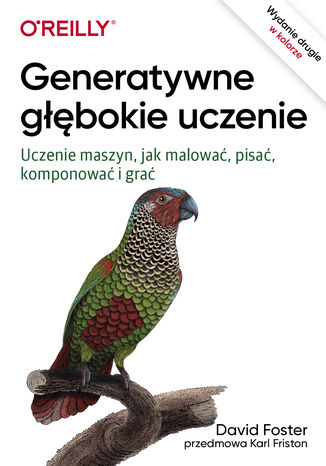
Generatywne głębokie uczenie, wyd. II. Uczenie maszyn, jak malować, pisać, komponować i grać
David Foster
Generatywna sztuczna inteligencja (AI) jest dziś gorącym tematem w dziedzinie techniki. Ta praktyczna książka pokazuje inżynierom uczenia się maszyn, jak wykorzystywać TensorFlow i Keras, aby od zera tworzyć robiące wrażenie generatywne modele głębokiego uczenia, w tym wariacyjne autokodowanie (VAE), generatywne sieci przeciwstawne (GAN), transformery, przepływy normalizacyjne, modele oparte na energii i dyfuzyjne modele odszumiające. Książka zaczyna się od podstaw głębokiego uczenia i prowadzi do nowatorskich architektur. Dzięki wskazówkom i sztuczkom zrozumiesz, jak sprawić, aby nasze modele uczyły się bardziej skutecznie i stawały się bardziej kreatywne. - Dowiedz się, jak VAE pozwala zmienić wyraz twarzy na zdjęciu. - Naucz GAN generowania obrazów na podstawie własnego zbioru danych. - Zbuduj modele dyfuzyjne do tworzenia nowych odmian kwiatów. - Wyszkol swój własny GPT, aby generował tekst. - Dowiedz się jak są szkolone duże modele językowe jak ChatGPT. - Przeanalizuj najnowocześniejsze architektury jak StyleGAN2 i ViT-VQGAN - Skomponuj muzykę polifoniczną wykorzystując transformery i MuseGAN - Zrozum jak generatywne modele świata mogą rozwiązać zadania uczenia przez wzmacnianie. - Zanurz się w multimodalnych modelach jak DALL.E 2, Imagen i Stable Diffusion Książka ta analizuje także przyszłą generacyjną sztuczną inteligencję i sposób, w jaki ludzie i firmy mogą proaktywnie zacząć wykorzystywać tę niezwykłą nową technikę, aby zyskiwać przewagę konkurencyjną. "Generatywne głębokie uczenie to dostępne wprowadzenie do narzędzi głębokiego uczenia dla celów modelowania generatywnego. Jeśli jesteście kreatywnymi praktykami, kochającymi bawić się kodem i chcecie zastosować głębokie uczenie w swojej pracy, ta książka jest dla was." -David Ha Szef strategii, Stability AT "Doskonała książka, która zagłębia się wprost w podstawowe technik stanowiące aktualną wiedzę o generacyjnym głębokim nauczaniu. Jest to ekscytująca analiza jednej z najbardziej fascynujących dziedzin w ramach sztucznej inteligencji!" -Francois Chollet Twórca Keras
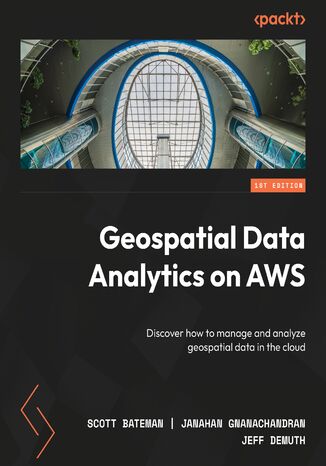
Geospatial Data Analytics on AWS. Discover how to manage and analyze geospatial data in the cloud
Scott Bateman, Janahan Gnanachandran, Jeff DeMuth
Managing geospatial data and building location-based applications in the cloud can be a daunting task. This comprehensive guide helps you overcome this challenge by presenting the concept of working with geospatial data in the cloud in an easy-to-understand way, along with teaching you how to design and build data lake architecture in AWS for geospatial data.You’ll begin by exploring the use of AWS databases like Redshift and Aurora PostgreSQL for storing and analyzing geospatial data. Next, you’ll leverage services such as DynamoDB and Athena, which offer powerful built-in geospatial functions for indexing and querying geospatial data. The book is filled with practical examples to illustrate the benefits of managing geospatial data in the cloud. As you advance, you’ll discover how to analyze and visualize data using Python and R, and utilize QuickSight to share derived insights. The concluding chapters explore the integration of commonly used platforms like Open Data on AWS, OpenStreetMap, and ArcGIS with AWS to enable you to optimize efficiency and provide a supportive community for continuous learning.By the end of this book, you’ll have the necessary tools and expertise to build and manage your own geospatial data lake on AWS, along with the knowledge needed to tackle geospatial data management challenges and make the most of AWS services.