
Techniki programowania
Dmitry Galkin
The job market related to the cloud and cloud-native technologies is both growing and becoming increasingly competitive, making certifications like KCNA a great way to stand out from the crowd and learn about the latest advancements in cloud technologies.Becoming KCNA Certified doesn't just give you the practical skills needed to deploy and connect applications in Kubernetes, but it also prepares you to pass the Kubernetes and Cloud Native Associate (KCNA) exam on your first attempt.The book starts by introducing you to cloud-native computing, containers, and Kubernetes through practical examples, allowing you to test the theory out for yourself. You'll learn how to configure and provide storage for your Kubernetes-managed applications and explore the principles of modern cloud-native architecture and application delivery, giving you a well-rounded view of the subject. Once you've been through the theoretical and practical aspects of the book, you'll get the chance to test what you’ve learnt with two mock exams, with explanations of the answers, so you'll be well-prepared to appear for the KCNA exam.By the end of this Kubernetes book, you'll have everything you need to pass the KCNA exam and forge a career in Kubernetes and cloud-native computing.
Beginning C++ Game Programming. Learn C++ from scratch and get started building your very own games
John Horton
This book is all about offering you a fun introduction to the world of game programming, C++, and the OpenGL-powered SFML using three fun, fully-playable games. These games are an addictive frantic two-button tapper, a multi-level zombie survival shooter, and a split-screen multiplayer puzzle-platformer.We will start with the very basics of programming, such as variables, loops, and conditions and you will become more skillful with each game as you move through the key C++ topics, such as OOP (Object-Orientated Programming), C++ pointers, and an introduction to the Standard Template Library. While building these games, you will also learn exciting game programming concepts like particle effects, directional sound (spatialization), OpenGL programmable Shaders, spawning thousands of objects, and more.
Albert Szmigielski
Blockchain is being billed as the technology of the future. Bitcoin is the first application of that technology. Mining is what makes it all possible. Exploring mining from a practical perspective will help you make informed decisions about your mining setup. Understanding what the future may hold for blockchains, and therefore for mining, will help you position yourself to take advantage of the impending changes.This practical guide starts with an introduction to Bitcoin wallets, as well as mining hardware and software. You will move on to learn about different mining techniques using the CPU, GPU, FPGA, and ultimately the ASIC as an example. After this, you will gain an insight into solo mining and pool mining, and see the differences between the two. The book will then walk you through large-scale mining and the challenges faced during such operations. Finally, you will take a look into the future to see a world where blockchain-based applications are commonplace and mining is ubiquitous.
Toi B. Wright, Scott Hanselman
Blazor WebAssembly allows you to build web apps without the need for JavaScript, plugins, or add-ons. With its continued growth in popularity, Blazor WebAssembly can open doors to new career paths and exciting projects, and Blazor WebAssembly by Example makes getting started easy. This project-based guide teaches you how to build single-page web applications by focusing heavily on the practical over the theoretical. The author provides step-by-step instructions for each project as well as a video of her following those exact steps.In this updated edition, we've added two new chapters on integrating artificial intelligence into web apps built with Blazor WebAssembly. You'll start with simple standalone web apps and gradually progress to hosted web applications with SQL Server backends. Each project covers a different concept from the Blazor WebAssembly ecosystem, such as Razor components, JavaScript interop, security, events, debugging, state management, hosted applications, REST APIs, and AI. The book's projects get more challenging as you progress, but you don't have to complete them in order, which makes this book a valuable resource for beginners as well as those who just want to dip into specific topics.By the end of this book, you'll be building your own web apps with .NET and C# using Blazor WebAssembly.
Toi B. Wright, Scott Hanselman
Blazor WebAssembly helps developers build web applications without the need for JavaScript, plugins, or add-ons. With its continued growth in popularity, getting started with Blazor now can open doors to new career paths and exciting projects – and Blazor WebAssembly by Example will make your first steps easier. This is a project-based guide that will teach you how to build single-page web applications with Blazor, focusing heavily on the practical over the theoretical by providing detailed step-by-step instructions for each project. The author also includes a video for each project showing her following the step-by-step instructions, so readers can use them if they're unsure about any particular step.In this updated edition, you'll start by building simple standalone web applications and gradually progress to developing more advanced hosted web applications with SQL Server backends. Each project will cover a different aspect of the Blazor WebAssembly ecosystem, such as Razor components, JavaScript interop, security, event handling, debugging on the client, application state, and dependency injection. The book’s projects get more challenging as you progress, but you don’t have to complete them in order, which makes this book a valuable resource for beginners as well as those who just want to dip into specific topics.By the end of this book, you will have experience and lots of know-how on how to build a wide variety of single-page web applications with .NET, Blazor WebAssembly, and C#.
Gordon Fisher
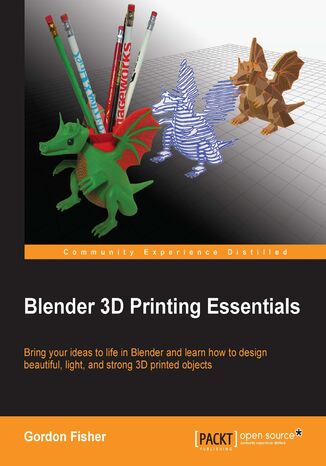
Like computing, 3D printing has been around for decades but it was expensive and was only used for making complex prototypes. Now, prices have dropped and third-party printing services such as Shapeways have become available, making the technology available to everyone.Blender is an open source modeling and animation program popular in the 3D printing community. 3D printing demands more of a modeler than animation or virtual reality. The model maker must engineer their model to work in the real world. They must keep in mind the particular needs of the materials and printers that they are planning to use to print their model. This practical guide gives Blender users all the information they need to design high-quality 3D printed objects. With a solid exploration of the 3D modeling process, design considerations for 3D printing, plus step-by-step exercises, you will soon be comfortable making 3D objects for real-world enjoyment. Starting with an overview of 3D printing, this guide moves onto to precision measurement, fixing problems in a 3D model, and how to make it light and strong enough for real-world use.You will learn how to scale, build, and detail a model for a 3D printer. You will learn to color and decorate it, as well as making parts precisely in the size you want them, so that multi-part objects fit together smoothly. You will also learn tips on saving money when you have printed your model.With the help of this guide, you will be able to complete your project and learn how to export the file so it is ready for a variety of 3D printers.
Silvio Moreto, Matt Lambert, Benjamin Jakobus, Jason...
Bootstrap framework's ease-of-use (along with its cross-browser compatibility, support for mobile user interfaces, and responsive web design capabilities) makes it an essential building block for any modern web application. With the first module, plunge into the Bootstrap frontend framework with the help of examples that will illustrate the use of each element and component in a proper way. You will get a better understanding of what is happening and where you want to reach. Also, you will gain confidence with the framework and develop some very common examples using Bootstrap. All these examples are explained step by step and in depth. The second module is a comprehensive tutorial; we'll teach you everything that you need to know to start building websites with Bootstrap 4 in a practical way. You'll learn about build tools such as Node, Grunt, and many others. You'll also discover the principles of mobile-first design in order to ensure that your pages can fit any screen size and meet responsive requirements. Learn Bootstrap's grid system and base CSS to ensure that your designs are robust and that your development process is speedy and efficient. Right from the first chapter of the third module, you'll delve into building a customized Bootstrap website from scratch. Get to grips with Bootstrap's key features and quickly discover the various ways in which Bootstrap can help you develop web interfaces. Once you reach the final pages of this book, you should have mastered the framework's ins and outs, and should be building highly customizable and optimized web interfaces. The course will enable you to rapidly build elegant, powerful, and responsive interfaces for professional-level web pages using Bootstrap 4.This Learning Path combines some of the best that Packt has to offer in one complete, curated package. It includes content from the following Packt products:? Bootstrap by Example – by Silvio Moreto? Learning Bootstrap 4, Second Edition – by Matt Lambert ? Mastering Bootstrap 4 – by Benjamin Jakobus and Jason Marah
Bass Jobsen, Ian Whitney, David Cochran
Packed with trade secrets, this second edition is your one-stop solution to creating websites that will provide the best experience for your users. We cover six popular, real-world examples, where each project teaches you about the various functionalities of Bootstrap 4 and their implementation.The book starts off by getting you up and running with the new features of Bootstrap 4 before gradually moving on to customizing your blog with Bootstrap and SASS, building a portfolio site, and turning it into a WordPress theme. In the process, you will learn to recompile Bootstrap files using SASS, design a user interface, and integrate JavaScript plugins. Towards the end of the book, you will also be introduced to integrating Bootstrap 4 with popular application frameworks such as Angular 2, Ruby on Rails, and React.