
Programowanie
Tony Fischetti
Frequently the tool of choice for academics, R has spread deep into the private sector and can be found in the production pipelines at some of the most advanced and successful enterprises. The power and domain-specificity of R allows the user to express complex analytics easily, quickly, and succinctly. Starting with the basics of R and statistical reasoning, this book dives into advanced predictive analytics, showing how to apply those techniques to real-world data though with real-world examples.Packed with engaging problems and exercises, this book begins with a review of R and its syntax with packages like Rcpp, ggplot2, and dplyr. From there, get to grips with the fundamentals of applied statistics and build on this knowledge to perform sophisticated and powerful analytics. Solve the difficulties relating to performing data analysis in practice and find solutions to working with messy data, large data, communicating results, and facilitating reproducibility.This book is engineered to be an invaluable resource through many stages of anyone’s career as a data analyst.
Manas Jain
Data Architecture for Data Engineers helps data engineers move beyond pipelines and tools to understand how scalable data solutions are designed.Starting with the foundations, you will learn the principles behind data architecture, including governance, data quality, security, scalability, accessibility, lineage, and stewardship. You’ll then work through data modeling and database design, comparing conceptual, logical, and physical models, relational databases, NoSQL databases, columnar databases, normalization, denormalization, and trade-offs behind design choices. The book then moves into data pipelines, covering ingestion, processing, storage, ETL, ELT, batch and real-time processing, monitoring, optimization, and robust design. You will compare data lakes, data warehouses, lakehouses, data mesh, and data fabric, and see where AWS, Azure, Databricks, Delta Lake, Snowflake, and pipeline tools fit into modern architectures. Practical scenarios show how industries shape requirements and why architecture must follow the use case, not trend. By the end, you will have a view of data solutions and a framework for choosing solutions that fit business needs.
Ryan Collingwood
In Data Contracts in Practice, seasoned business-IT strategist Ryan Collingwood draws on over 20 years of cross-functional expertise in product management, data analysis, and software development to offer a transformative approach to managing complex data ecosystems in organizations of all sizes. He introduces data contracts as a powerful tool for formalizing expectations, roles, and guarantees of data exchange across domain boundaries and organizational structures, whether centralized or decentralized.Through real-world examples in retail customer marketing segmentation, you'll navigate the entire data contracts lifecycle—from creation to deployment and enforcement, covering essential topics such as requirements gathering, quality assurance, and change management, equipping you with the skills to integrate data contracts in your continuous development cycle.You'll integrate data contracts into existing workflows, addressing the perspectives of both data producers and consumers, and learn proactive strategies for identifying and addressing data drift, ensuring your data management practices remain robust and adaptable.By the end of this book, you’ll be prepared to tackle data challenges with a techno-social approach that balances system-level control and organizational alignment, to build solutions that are both useful and used.
Jeff Burtenshaw
Domo is a power-packed business intelligence (BI) platform that empowers organizations to track, analyze, and activate data in record time at cloud scale and performance.Data Democratization with Domo begins with an overview of the Domo ecosystem. You’ll learn how to get data into the cloud with Domo data connectors and Workbench; profile datasets; use Magic ETL to transform data; work with in-memory data sculpting tools (Data Views and Beast Modes); create, edit, and link card visualizations; and create card drill paths using Domo Analyzer. Next, you’ll discover options to distribute content with real-time updates using Domo Embed and digital wallboards. As you advance, you’ll understand how to use alerts and webhooks to drive automated actions. You’ll also build and deploy a custom app to the Domo Appstore and find out how to code Python apps, use Jupyter Notebooks, and insert R custom models. Furthermore, you’ll learn how to use Auto ML to automatically evaluate dozens of models for the best fit using SageMaker and produce a predictive model as well as use Python and the Domo Command Line Interface tool to extend Domo. Finally, you’ll learn how to govern and secure the entire Domo platform.By the end of this book, you’ll have gained the skills you need to become a successful Domo master.
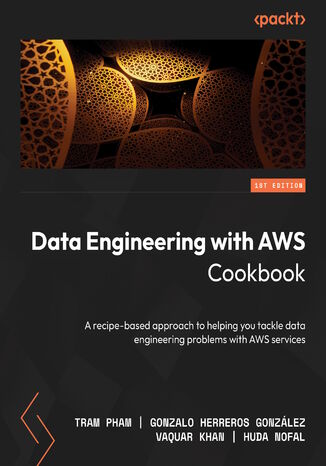
Trâm Ngoc Pham, Gonzalo Herreros González, Viquar...
Performing data engineering with Amazon Web Services (AWS) combines AWS's scalable infrastructure with robust data processing tools, enabling efficient data pipelines and analytics workflows. This comprehensive guide to AWS data engineering will teach you all you need to know about data lake management, pipeline orchestration, and serving layer construction.Through clear explanations and hands-on exercises, you’ll master essential AWS services such as Glue, EMR, Redshift, QuickSight, and Athena. Additionally, you’ll explore various data platform topics such as data governance, data quality, DevOps, CI/CD, planning and performing data migration, and creating Infrastructure as Code. As you progress, you will gain insights into how to enrich your platform and use various AWS cloud services such as AWS EventBridge, AWS DataZone, and AWS SCT and DMS to solve data platform challenges.Each recipe in this book is tailored to a daily challenge that a data engineer team faces while building a cloud platform. By the end of this book, you will be well-versed in AWS data engineering and have gained proficiency in key AWS services and data processing techniques. You will develop the necessary skills to tackle large-scale data challenges with confidence.
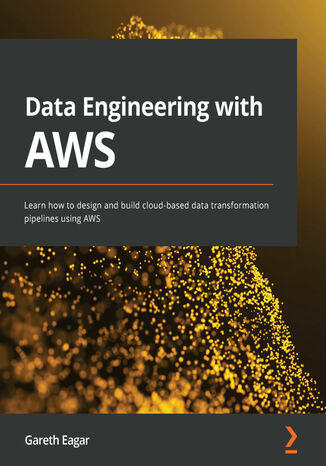
Gareth Eagar
Written by a Senior Data Architect with over twenty-five years of experience in the business, Data Engineering for AWS is a book whose sole aim is to make you proficient in using the AWS ecosystem. Using a thorough and hands-on approach to data, this book will give aspiring and new data engineers a solid theoretical and practical foundation to succeed with AWS.As you progress, you’ll be taken through the services and the skills you need to architect and implement data pipelines on AWS. You'll begin by reviewing important data engineering concepts and some of the core AWS services that form a part of the data engineer's toolkit. You'll then architect a data pipeline, review raw data sources, transform the data, and learn how the transformed data is used by various data consumers. You’ll also learn about populating data marts and data warehouses along with how a data lakehouse fits into the picture. Later, you'll be introduced to AWS tools for analyzing data, including those for ad-hoc SQL queries and creating visualizations. In the final chapters, you'll understand how the power of machine learning and artificial intelligence can be used to draw new insights from data.By the end of this AWS book, you'll be able to carry out data engineering tasks and implement a data pipeline on AWS independently.
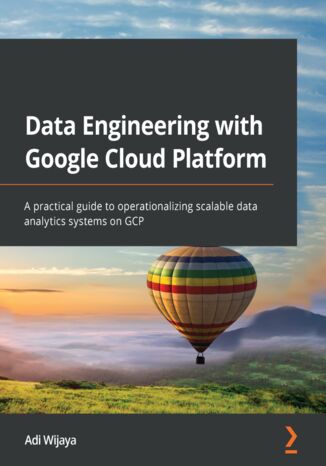
Adi Wijaya
With this book, you'll understand how the highly scalable Google Cloud Platform (GCP) enables data engineers to create end-to-end data pipelines right from storing and processing data and workflow orchestration to presenting data through visualization dashboards.Starting with a quick overview of the fundamental concepts of data engineering, you'll learn the various responsibilities of a data engineer and how GCP plays a vital role in fulfilling those responsibilities. As you progress through the chapters, you'll be able to leverage GCP products to build a sample data warehouse using Cloud Storage and BigQuery and a data lake using Dataproc. The book gradually takes you through operations such as data ingestion, data cleansing, transformation, and integrating data with other sources. You'll learn how to design IAM for data governance, deploy ML pipelines with the Vertex AI, leverage pre-built GCP models as a service, and visualize data with Google Data Studio to build compelling reports. Finally, you'll find tips on how to boost your career as a data engineer, take the Professional Data Engineer certification exam, and get ready to become an expert in data engineering with GCP.By the end of this data engineering book, you'll have developed the skills to perform core data engineering tasks and build efficient ETL data pipelines with GCP.
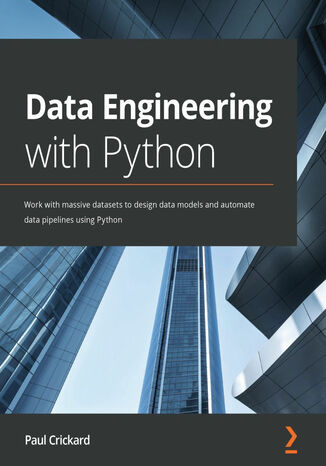
Paul Crickard
Data engineering provides the foundation for data science and analytics, and forms an important part of all businesses. This book will help you to explore various tools and methods that are used for understanding the data engineering process using Python.The book will show you how to tackle challenges commonly faced in different aspects of data engineering. You’ll start with an introduction to the basics of data engineering, along with the technologies and frameworks required to build data pipelines to work with large datasets. You’ll learn how to transform and clean data and perform analytics to get the most out of your data. As you advance, you'll discover how to work with big data of varying complexity and production databases, and build data pipelines. Using real-world examples, you’ll build architectures on which you’ll learn how to deploy data pipelines.By the end of this Python book, you’ll have gained a clear understanding of data modeling techniques, and will be able to confidently build data engineering pipelines for tracking data, running quality checks, and making necessary changes in production.